
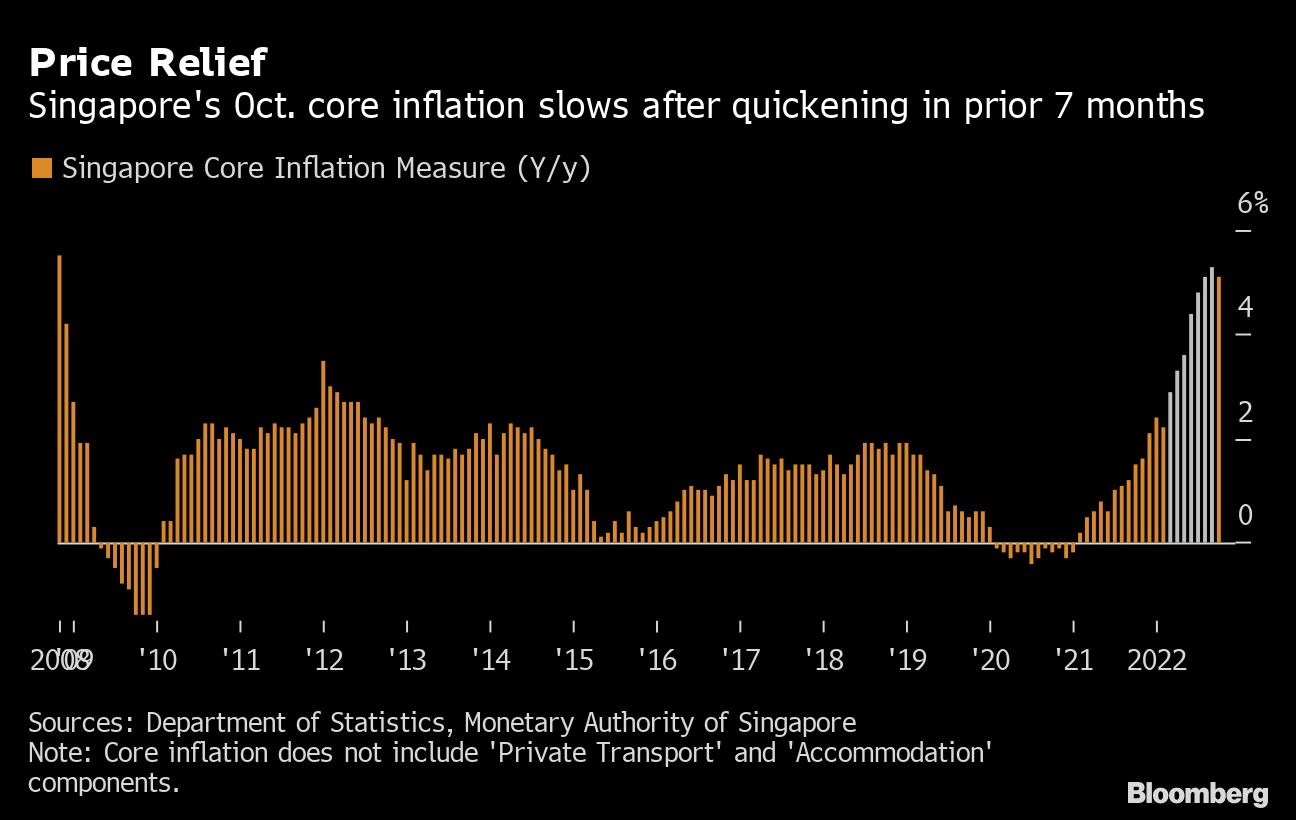
(Bloomberg) — Singapore’s core inflation gauge eased for the first time in eight months in October, giving policymakers reason to refrain from tightening monetary policy amid mounting risks to economic growth.
Core inflation, which excludes private transport and accommodation and is closely watched by the central bank, rose 5.1% from a year ago, according to a joint statement Wednesday from the Monetary Authority of Singapore and the Ministry of Trade and Industry.
That was slower than economists’ median forecast for a 5.3% gain, as well as September’s rate, which was the fastest pace since November 2008.
The moderation in core inflation was driven by smaller increases in the prices of electricity and gas, retail and other goods and services, according to the statement.
The all-items consumer price index gained 6.7% from year ago, compared with a median estimate of 7% in a Bloomberg survey, and 7.5% the previous month.
The data gives policymakers space to weigh a monetary-tightening pause after five moves since October last year.
The case for refraining from making any further adjustments was boosted by gross domestic product data earlier Wednesday that showed third-quarter growth was weaker than initially seen, and expansion will likely slow sharply next year on account of a global slowdown.
“This print does give some hope that MAS can give more consideration to the growth-linked aspects of its mandate,” Philip McNicholas, Asia sovereign strategist at Robeco Group in Singapore, said, referring to the easing pace of food inflation — a major component that gave a positive impulse to the core print.
For 2022 as a whole, all-items inflation is expected to average around 6%, and the core gauge is expected to be around 4%, according to the statement.
For 2023, both the measures are expected to average 5.5%–6.5% and 3.5–4.5%, respectively, as a result of the proposed increase in goods and services tax.
The core inflation measure is projected to stay elevated in the next few quarters before “slowing more discernibly” in the second-half of 2023 as the current tightness in the domestic labor market eases and global inflation moderates, according to the statement.
–With assistance from Tomoko Sato and Chester Yung.
(Updates with economist comments in the sixth paragraph.)
More stories like this are available on bloomberg.com
©2022 Bloomberg L.
P.