
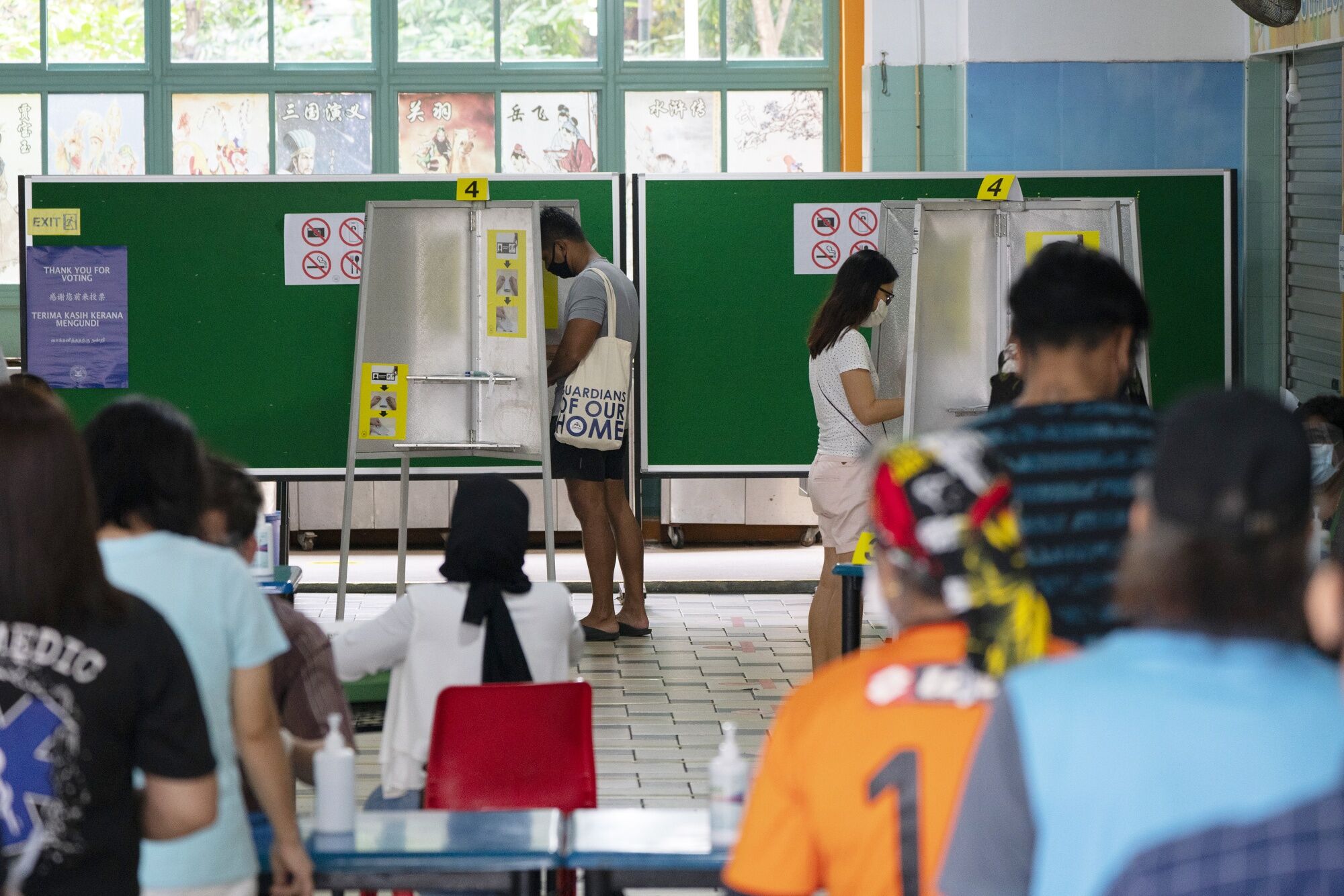
(Bloomberg) — Singapore headed to the polls Friday as Prime Minister Lee Hsien Loong’s ruling party seeks to extend its 55-year rule with a fresh mandate to counter the city-state’s worst-ever recession amid the coronavirus pandemic.
Sample ballot counts released in several constituencies showed the ruling People’s Action Party leading, but by smaller margins than in 2015. The Election Department caveated release of those sample counts by saying the full counting is still in process and final results could be different.
The initial sample counts released didn’t include the most closely-watched seats such as Aljunied, East Coast, or West Coast.
Wearing masks and observing strict social distancing at polling booths, all voters had their temperature screened as authorities worked to ensure safety amid the Covid-19 outbreak that’s shaken the city-state. Counting began immediately after polls closed, with the final outcome likely to be clear late Friday or early Saturday.
While Singapore bans opinion polls during election campaigns, analysts and the opposition parties expect the PAP to form the next government.
It’s been in power since the country’s independence in 1965 and has never won less than 93% of parliamentary seats, despite seeing its popular vote slip as low as 60% in 2011.
Here are the latest updates (all times Singapore):
PAP vote share declines in first sample counts (11:38 p.m.)
The first sample ballot counts released on election night in Singapore showed the ruling People’s Action Party leading in several districts, but in many cases by less than their winning margin in 2015.
The PAP’s vote share in the sample count declined in five districts across the country from 2015 final results, though they still led in every one.
In Marine Parade for example, where former Prime Minister Goh Chok Tong recently retired, the sample count showed PAP’s vote share slipping by about 7 percentage points, even as the ruling party held a double-digit lead for the seat.
The Election Department issued a statement to caveat the announcements:
“As this is a sample count, the election result could be different. Counting is still in progress.
The public should wait for the announcement of the election result by the Returning Officer, Mr Tan Meng Dui, which will be broadcast ‘live’ on television.”
Sample counts coming up (11:24 p.m.)
Before the final votes are released, the Elections Department will release sample counts for this year’s elections, giving an early indication of the possible outcomes for the various constituencies.
Think of it as a sort of exit poll as might be seen in the U.
S. or other countries, except this is actual ballots cast, not an opinion survey. Sample counts are derived from a random sampling of ballot papers from each polling station within a constituency.
This is the second time sample counts will be released, the first being in the 2015 polls. Local media have reported a margin error of up to four percentage points.
Singapore polls close, counting starts (10 p.m)
Polls have closed in the city-state after an intense campaign period that has focused on issues from creating jobs to the government’s handling of the coronavirus pandemic.
All eyes are on how the ruling People’s Action Party will perform this time around, compared to the 69.9% of votes it got in 2015.
Turnout headed for possible record high (9:32 p.m.)
With about 96% of registered Singaporeans casting their ballots as of 8 p.m., the Elections Department announced more than 2.5 million votes have been cast so far in Singapore’s general elections.
That’s higher than 2015, when about 2.3 million people cast votes.
It also defended its decision to prolong polling by two hours saying “the decision to extend polling hours was made because there was still a small number of polling stations with long queues.” It said in a separate statement there will be no changes to polling and vote counting procedures.
Polling hours were extended until 10 p.m. across much of the island.
At least two opposition parties criticized the extension. The Singapore Democratic Party called it “highly irregular,” while both they and the People’s Power Party said there were logistical problems raised by the extension.
Poll closing times extended (7:24 p.m.)
Singapore extended the hours for most polling stations to 10 p.m., a two hour extension as the city-state reported long lines to vote.
The extension will slightly delay results here, as counting is set to begin after polls close.
Voter turnout (6:30 p.m.)
Some 2.16 million people, or 81% of those registered to vote, have cast their ballots as of 5:00 p.m local time, according to the Elections Department. In the 2015 elections, the total turnout was 93.56%.
Teething problems (4:50 p.m.)
“I think the queues are a bit longer.
But the officers are trying their best,” Prime Minister Lee Hsien Loong was cited as saying by Channel News Asia before casting his vote.
“From what I know, the teething problems have been sorted out and it’s running smoothly now.”
Ruling party’s challenge (1:15 p.m.)
The People’s Action Party (PAP) came to the election confident that voters would endorse its Covid-19 response, the University of Nottingham Asia Research Institute Malaysia honorary research associate, Bridget Welsh, told Bloomberg TV in an interview Friday.
“I think they will get a majority of the voters to do that,” Welsh said. “But at the same time, the campaign itself has been very negative.
The PAP has been on the defensive. The issues that have been raised will be things that PAP will have to grapple with irrespective of what happens in the contest.
“It puts PAP very much in the hot seat given the fact that they have not controlled the election narrative.”
Long queues and disposable gloves (12 p.m.)
The Elections Department apologized for the longer-than-usual queues for voting, caused when people arrived outside their assigned time for casting their vote.
“This, together with measures that had been put in place to ensure safe voting, had led to long queues,” the department said in a statement. “To address the long wait, we did away with the requirement to don disposable gloves, as voters would already be required to sanitize their hands.
We observed that this step in particular contributed to the longer than usual voting times. Gloves are still available for voters who would like to use both sanitizer and gloves.”
Polls open (8:00 a.m.)
Singaporeans began voting in what could be Lee’s final election before he hands power to the so-called “fourth generation” of People’s Action Party (PAP) officials led by Deputy Prime Minister Heng Swee Keat, who have helped spearhead the government’s response to Covid-19.
Any drop in support compared with the last election in 2015 — or even a more extreme scenario where the PAP fails to win a two-thirds majority in Parliament for the first time — could potentially affect Lee’s succession plan or prompt the government to adopt more populist measures like it did in 2011 following its worst-ever result
For more articles like this, please visit us at bloomberg.com
©2020 Bloomberg L.
P.