
(Bloomberg) — GIC Pte has reported its worst 20-year annualized result in more than a decade and warned of lower returns and elevated market volatility as the coronavirus outbreak ravages global economies.
Singapore’s sovereign wealth fund on Tuesday reported a 20-year real return of 2.7%, down from the 3.4% it announced last year and its worst performance on that metric since 2009 when it lost over one-fifth of its value in a single year.
The firm said that the dot-com bubble of the late 1990s falling out of its rolling two-decade investment window caused most of the decline, rather than March’s market turmoil. GIC doesn’t release one-year performance figures.
GIC’s continued skepticism about a global economic comeback is bad news for the market because the Singaporean fund is one of the world’s largest dealmakers. While it officially manages “over $100 billion” in assets and declines to provide an exact figure, the Sovereign Wealth Fund Institute estimates its holdings are around $440 billion.
“The timing and shape of the recovery is highly unclear, partly because of the infection rate,” said GIC Chief Executive Officer Lim Chow Kiat, adding that the slowdown of globalization and impact from government stimulus measures were all complicating factors. “The economy continues to face a lot of headwinds.”
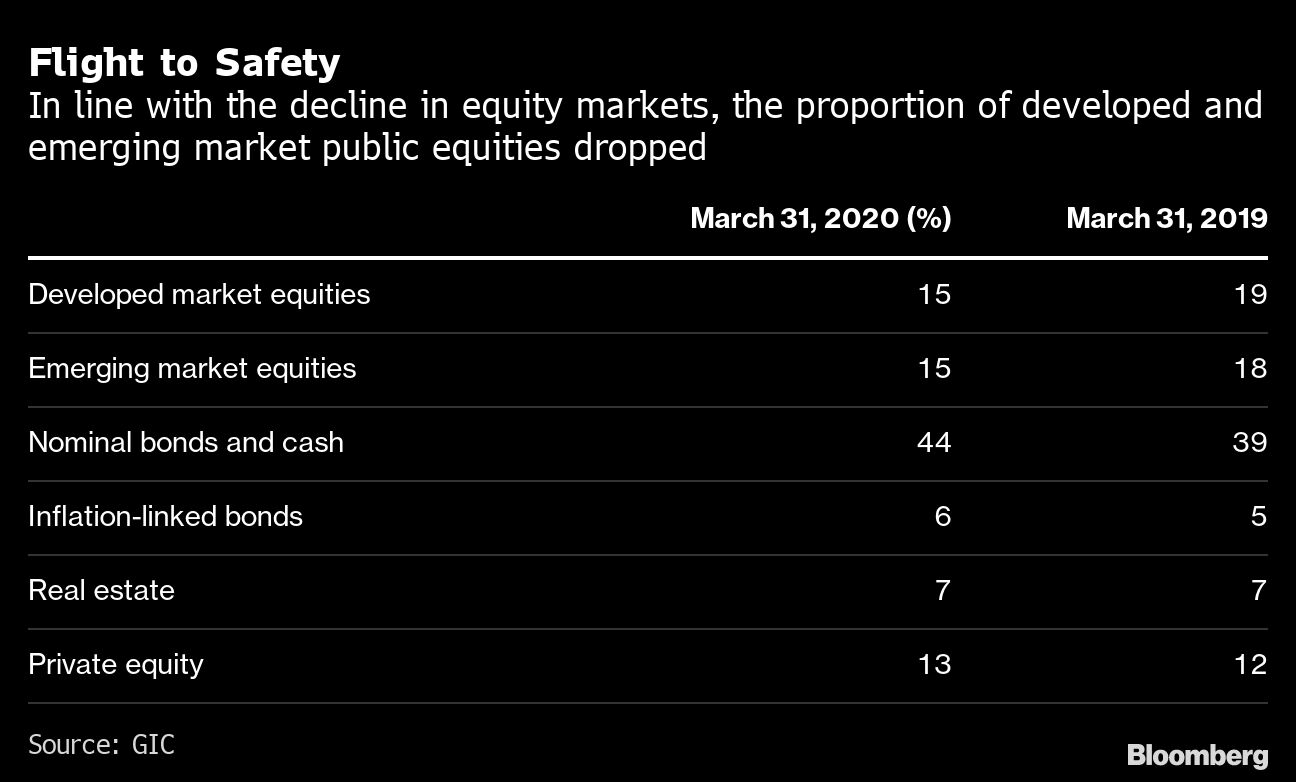
GIC said March’s stock rout didn’t play a material part in its long-term returns because the fund had already become more defensive due to high valuations and geopolitical uncertainty; in the past three years it’s slashed the percentage of assets it invests in developed-market shares from 27% of the portfolio to 15% as of March 31, 2020.
The firm’s nominal annualized return over a five-year period also fell to 3.9%, versus 4.9% last year.
Read more: Temasek Reports Worst Year Since 2016 Amid Volatile Markets
GIC under Lim’s leadership has repeatedly warned of falling returns caused by geopolitical tensions and bubbly valuations. Last year, he signaled that investors faced rising uncertainty and recommended raising dry powder in the form of cash.
Even so, the pandemic’s effects on global markets are forcing it to re-evaluate much of its investment universe.
One key area of focus is real estate because GIC is one the world’s biggest property investors. While logistics and data centers remain solid prospects, Group Chief Investment Officer Jeffrey Jaensubhakij said GIC is reviewing the long-term fortunes of more vulnerable segments.
Offices, Hotels
“We’re looking very carefully in ascending order of concern at offices, hotels and shopping centers with student housing somewhere in between shopping centers and hotels, and asking what is likely to be permanent damage versus cyclical,” he said during a virtual briefing in Singapore Monday. “Even at the end of the recession there could be permanent damage.”
The pandemic has also hurt other parts of its investment sphere.
Earlier this year both GIC and Carlyle Group Inc. asked a U. S. court to scrap a deal they’d struck to buy a stake in American Express Global Business Travel.
On investing in a low-rate environment:
“You try to emphasize those assets which still could go through ups and downs, but cash flow is more resilient. You find them in credit, corporates, structured, even in some emerging-market government bonds.
That’s an area we’re diverisfying to. It’s hard to replace the safe bonds that everyone has been enjoying for a long time.”
Lim Chow Kiat, GIC CEO
But both Lim and Jaensubhakij said GIC has plenty of dry powder to make investments if it sees opportunities. The firm’s headcount has grown by 200 staff to 1,700 globally, including some 700 dedicated investment personnel. While some opportunities came about when the markets first crashed in the wake of Covid-19, these quickly evaporated as government stimulus packages and continued low-interest rates sent valuations soaring.
One area where GIC may search for potential partners is the hotel space in large countries like China and Australia where domestic tourism could receive a boost as restrictions on international travel persist.
And while the firm expects geopolitical strife between the U.
S. and China to remain for the foreseeable future — an uneasy prospect considering over half of its portfolio is distributed between the U. S. and Asia excluding Japan — it’s also hunting for potential wins amid the trade war.
“As the U. S. and China battle it out on the technology leadership front, China will definitely want to be more self-sufficient in some areas where it feels that it’s behind and is dependent on the U.
S.,” Jaensubhakij said. “There’ll be opportunities in the Chinese investment area where they’re going to push domestic self-sufficiency.”
For more articles like this, please visit us at bloomberg.com
©2020 Bloomberg L. P.