
Spanish Inflation Quickens in First Glimpse of Key Data for ECB
(Bloomberg) — Spanish inflation quickened again in the first of a string of reports from around the region that will help European Central Bank officials judge whether to keep raising interest rates.
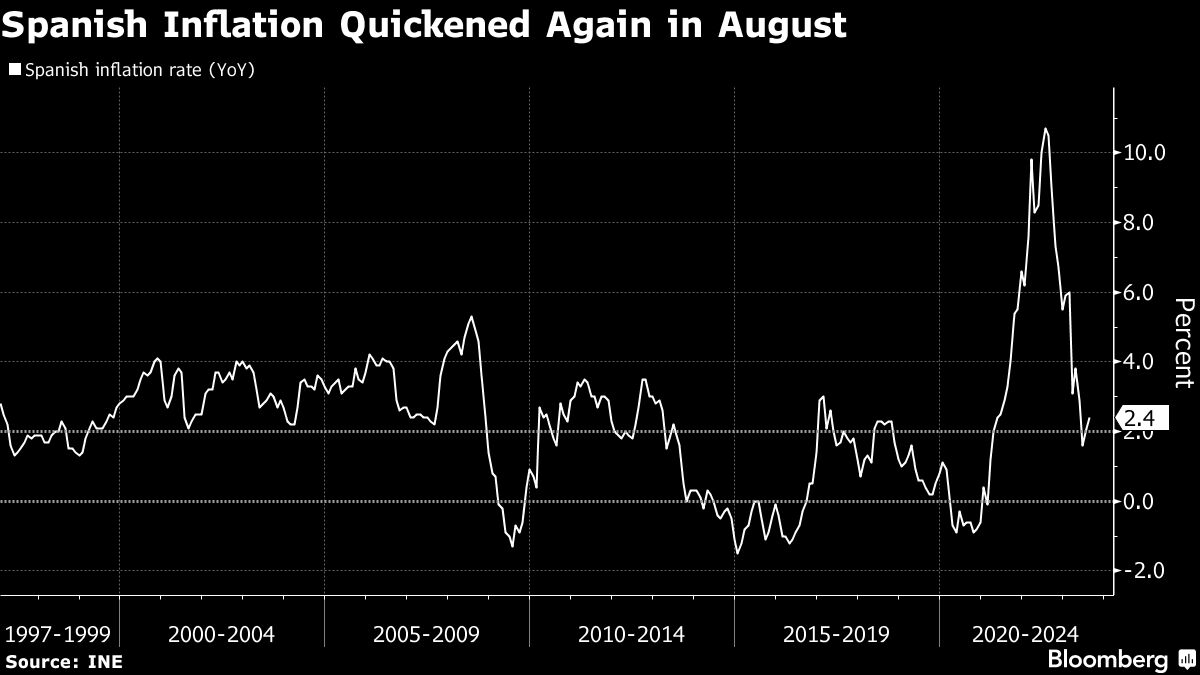
Consumer prices rose 2.4% in August from a year earlier, up from 2.1% the prior month, driven by fuel costs, the country’s statistics agency said on Wednesday.
The outcome matched the median estimate in a Bloomberg survey of economists.
It’s the second consecutive month of acceleration.
The euro and bonds held losses after the data, as traders firmed bets the ECB will raise rates one more time this cycle to 4%. Money market pricing implies a roughly 60% chance it could chose to hike by 25 basis points next month.
The numbers from the region’s fourth-biggest economy kick off more than 24 hours of national reports that will ultimately lead to the release of euro-zone inflation on Thursday, which is seen likely to show underlying price pressures still stubbornly stuck above 5%.
That’s more than twice the goal targeted by ECB officials, who have identified this week’s data as pivotal for a cliffhanger decision on Sept. 14.
Policymakers will determine then if a 10th consecutive hike in borrowing costs is needed to tame inflation, or whether the euro-zone is weak enough to warrant a pause.
More significant in their judgment than Spain will be figures later on Wednesday from Germany, the region’s biggest economy, that are likely to show consumer prices are still growing at an annual pace exceeding 6%.
Initial data released earlier on Wednesday from North Rhine-Westphalia, the most populous German state, showed inflation at 5.9%, up from 5.8% in July.
French numbers on Thursday are anticipated by economists to show quickening further above 5%, while Italy’s outcome is seen slowing though still stuck above that level.
The report for overall consumer-price growth in the euro region will also be published on Thursday.
So-called core inflation that strips out volatile food and energy prices, a measure ECB officials are studying closely, is expected to come in at 5.3%, according to forecasters’ median estimate.
Policymakers have framed the data as crucial. Austria’s Robert Holzmann, an ECB hawk, told Bloomberg earlier this week that he favors another rate hike “if there aren’t any big surprises.”
His Finnish colleague Tuomas Valimaki said on Tuesday that the Governing Council is “totally open” on what to do and that any move is “dependent on incoming data.”
Spain has recently enjoyed some of the region’s lowest price growth, even including a dip below 2% in June.
That’s expected to reverse later this year as base effects change.
Underlying inflation has remained stubbornly high, in common with the overall euro area. That measure, based on Spanish methodology, was at 6.1% in August.
The country faces additional uncertainty amid a political stalemate after an inconclusive election in July that left both main candidates — opposition leader Alberto Nunez Feijoo and Prime Minister Pedro Sanchez — short of a majority in parliament.
Sanchez campaigned on a platform that emphasized Spain’s economic performance and the fight against inflation.
Feijoo, who won the most votes, has been invited by King Felipe VI to try to form a government even though he doesn’t have enough support from lawmakers.
The investiture debate is scheduled for Sept. 26 and 27.
–With assistance from Joshua Robinson, Joel Rinneby and Constantine Courcoulas.
(Updates with markets in fourth paragraph)
More stories like this are available on bloomberg.com
©2023 Bloomberg L. P.