
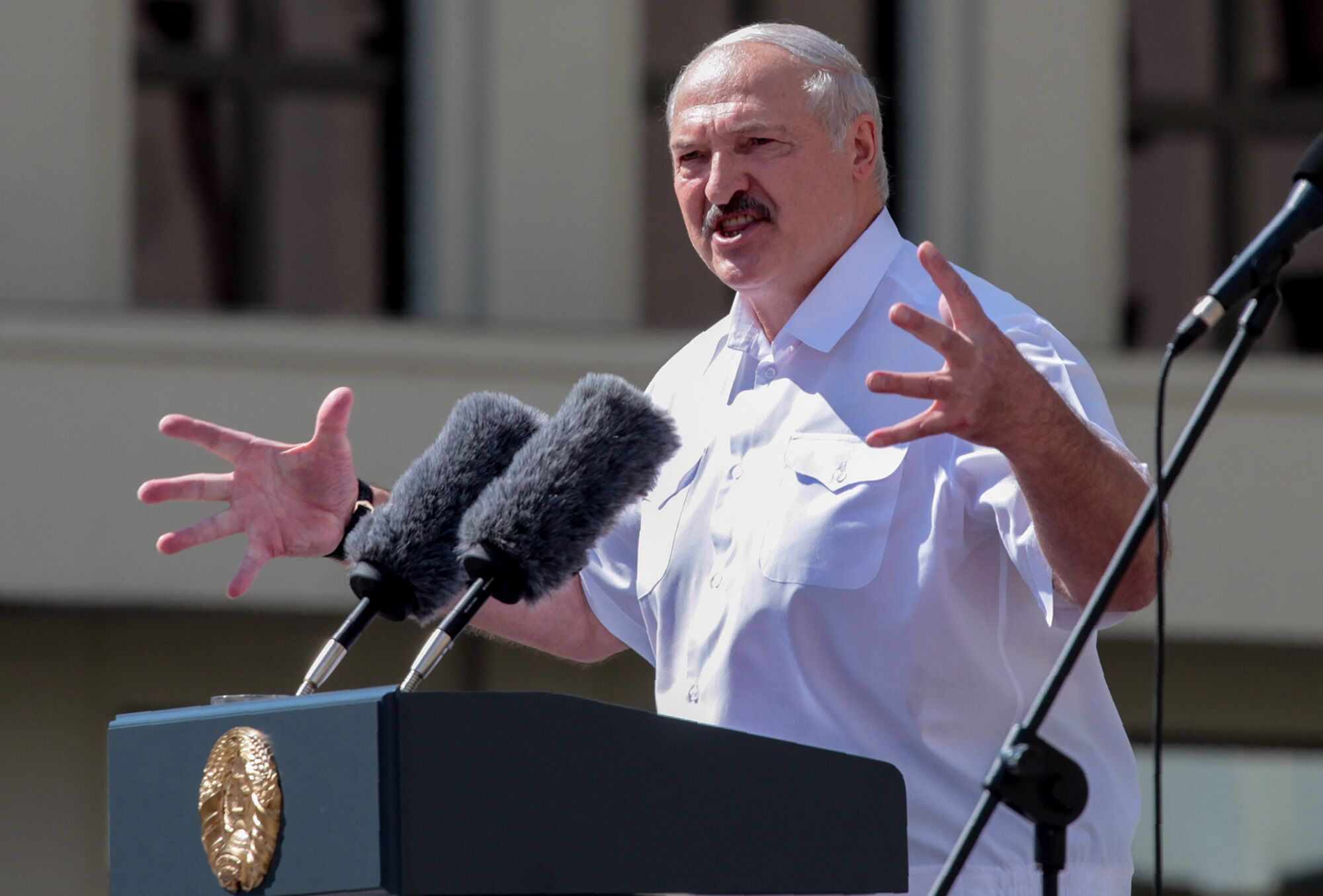
(Bloomberg) — Workers across Belarus went on strike and joined mass protests against long-time ruler Alexander Lukashenko, who was met with jeers and calls to resign when he visited a factory in the capital, Minsk, on Monday.
Lukashenko insisted he won’t step down and instead proposed changes to the constitution, a theme he has raised repeatedly in the past without making progress.
“We need to adopt a new constitution,” which must be approved by a referendum, he said during the visit to the Minsk Wheel Tractor Plant factory.
Then, “according to the new constitution, hold, if you want, elections for parliament, president and local authorities.”
With Belarus roiled by huge protests since the disputed Aug. 9 presidential election, it’s unlikely Lukashenko retains sufficient political credibility or popular support to push through constitutional reforms now. Hours earlier, opposition leader Svetlana Tikhanovskaya said in a new video address that she’s ready to “act in this period as national leader” in place of Lukashenko until new elections can be held.
As Tikhanovskaya spoke from exile in Lithuania, thousands of employees in major Belarusian state-run factories walked out in support of opposition calls for a general strike.
That came a day after hundreds of thousands of protesters took to the streets in Minsk and other Belarusian cities to call for Lukashenko to resign.
“We held elections,” Lukashenko told workers at the factory, according to the Tut.by news website. “Until you kill me, there won’t be another election.”
He dismissed the strikers as a small minority, state TV reported. As he spoke, crowds of people, including workers from other factories, gathered outside the gates of the plant, chanting for his resignation.
Tikhanovskaya’s campaign ally, Maria Kalesnikava, urged striking workers to nominate representatives to a national coordination council being formed by the opposition movement.
Some employees of the state TV and radio holding joined the strike Monday, calling for the election result to be annulled and demanding an end to censorship, Tut.by reported.
The protests, which started with Lukashenko’s claim of a landslide victory with 80% of the vote, have spiraled into the largest ever seen in Belarus, fueled by anger at the severity of the police violence in response, including accusations of torture and the deaths of at least two people.
Security forces have largely stood aside since Friday, however.
“People have overcome fear — it means we have a future,” Viktor Babariko, one of the challengers to Lukashenko who was jailed shortly before the election, said in a statement through his lawyers who visited him in detention Monday.
European Union leaders will hold an extraordinary video call on Wednesday to send a message of solidarity to the people of Belarus, according to an EU official familiar with the plans for the summit.
They’ll seek to convey to the people of Belarus that they have the right to choose their own president, said the official, who asked not to be identified because the deliberations were private.
Polish President Andrzej Duda said he held a conference call Monday with his counterparts from Lithuania, Latvia and Estonia on the situation in Belarus “especially in the context of regional security.”
Belarus Eurobonds due in 2031 dropped for a third day, lifting the yield more than half a percentage point to 8.1%.
Russia‘s 10-year ruble yield climbed 22 basis points to 6.24%, the biggest increase on a closing basis since March. The ruble was one of the worst performers in emerging markets with a 0.8% drop against the dollar.
Appeal to Russia
Lukashenko, who held his own much smaller rally on Sunday, has appealed to Russia for support, twice speaking to Russian President Vladimir Putin during the weekend.
Russia is ready to provide assistance to Belarus in “resolving the problems” that arose after the election, including within the countries’ security alliance “if necessary,” the Kremlin said Sunday in a statement.
It’s unclear how Russia could provide assistance through the collective defense pact unless there was an external threat to Belarus, said Fyodor Lukyanov, head of the Council on Foreign and Defense Policy, a research group that advises the Kremlin. “I think this is Lukashenko’s move to scare his own people – ‘if not me, then Putin’,” Lukyanov said.
The Kremlin was betting that Lukashenko would manage to extend his 26-year rule for a sixth term, with his harsh tactics leaving him isolated in the West and ever more dependent on Russia.
The Belarusian leader has been resisting Russian demands for closer political and economic integration, wary of a takeover by his larger neighbor.
For more articles like this, please visit us at bloomberg.com
©2020 Bloomberg L. P.