
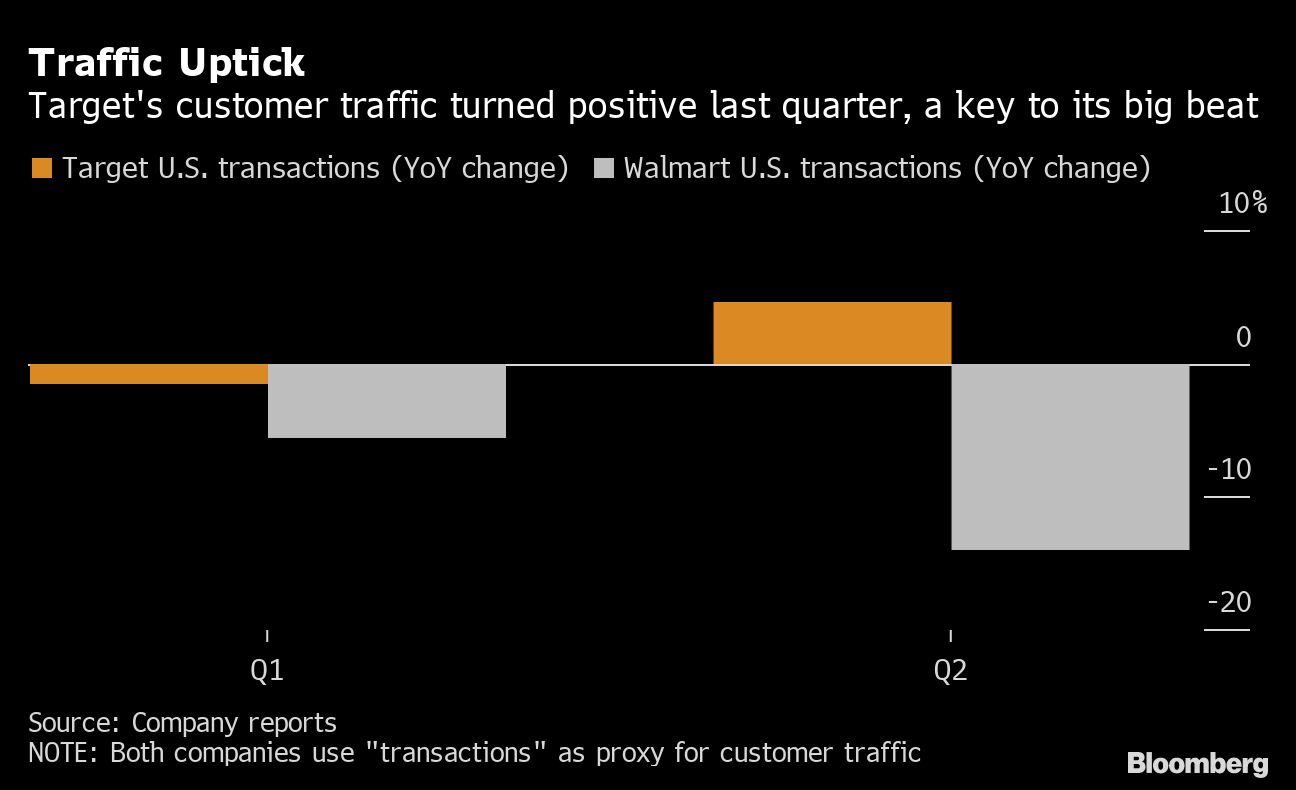
(Bloomberg) — For nearly all retailers, the pandemic has meant shoppers check out less often and stock up on each trip. But Target Corp. bucked that trend by attracting more visits last quarter, fueling record sales and profits.
That’s a feat even chief rival Walmart Inc. couldn’t pull off, with the bigger retailer reporting on Tuesday a 14% drop in U. S. transactions — a proxy for both in-person and online customer traffic.
Target’s, meanwhile, rose 4.6%.
Target also got shoppers back inside stores, not just filling their carts from the comfort of their couches. The retailer posted a 10.9% increase in comparable sales for its brick-and-mortar stores in the second quarter ended Aug. 1. That excludes the web operations, and shows that even at a time when Americans are leery of venturing inside a retailer’s four walls, Target can still draw them in thanks to its merchandising.
Shares rose as much as 9.8% before the start of regular trading in New York.
They were already up 6.8% year to date, slightly outpacing the S&P 500.
Target’s beat continues a run of solid performance that now stretches more than two years, as Chief Executive Officer Brian Cornell has introduced a slew of fashionable-yet-affordable private brands, remodeled hundreds of stores and bolstered the retailer’s e-commerce offerings. That model has kept Target on par with Walmart and has also proved to be a winning formula during the pandemic.
With shoppers generally leery of venturing into brick-and-mortar environments, Target’s merchandise selection and safety measures have given them a measure of comfort and a willingness to spend.
Target’s comparable sales rose 24% in the quarter, the fastest pace in the retailer’s 58-year history, and almost three times higher than the average estimate of 8.6% compiled by Consensus Metrix.
Adjusted earnings per share also touched an all-time high.
Stimulus Effect
The retailer brushed off concerns that demand would ebb after consumers spent their relief checks. Walmart said Tuesday that government stimulus checks provided a boost in its second quarter, but the benefit faded by July. In contrast, Cornell said that although relief checks helped goose demand, Target’s shoppers kept buying well into July even as the stimulus’s impact waned.
“The stimulus was a factor, but even as it waned we saw strong comparable-sales growth in June and July,” he said. “And we are off to a very solid start in August.
Target said it experienced “unusually strong” market share gains across its five core merchandise categories.
That’s a sign that the breadth of the retailer’s offering — from food and apparel to home furnishings and toys — is resonating with consumers that are making fewer shopping trips amid the pandemic.
Clothing sales bounced back from a 20% decline the previous quarter to double-digit growth — a notable development given apparel’s general weakness this year. Target’s home decor sales, meanwhile, shot up more than 30%, while beauty’s gain exceeded 20%.
Online Boost
The gains were sparked by new shoppers and online growth, particularly in web orders fulfilled that same day.
Target reported 10 million new online customers in the first half of the year, spread evenly between the two quarters, showing the company’s continued ability to attract first-time digital shoppers.
Still, there are some weaker spots. Cornell said the school-shopping season has “started more slowly than usual,” but said comparable sales so far in August were still above 10%.
The return to classes is typically a key period for Target, given its focus on kids’ apparel and school accessories, along with its growing number of small-format stores located on or near college campuses.
The company said it will feature its back-to-school assortment for an extended period this year, allowing parents to delay shopping until they have more certainty on school districts’ plans.
For more articles like this, please visit us at bloomberg.com
©2020 Bloomberg L. P.