
Treasury Traders Bail on Flattener Trades Before Inflation Data
(Bloomberg) — Wall Street traders have been cashing out of bets on a further flattening of the Treasury yield curve ahead of Wednesday’s key inflation data.
With the negative gap between short- and long-term yields getting less extreme — a dynamic known as steepening — money managers are navigating renewed volatility fueled by a positioning washout and uncertainty over the Federal Reserve’s policy trajectory.
All told, the story in the world’s biggest bond market in recent sessions has been a painful unwinding of wagers that the spread between front- and long-end rates will flatten or invert anew.
Meanwhile JPMorgan Chase & Co.’s weekly survey released Tuesday shows clients are continuing to unwind positions in Treasuries, with outright longs beginning to retreat from the most elevated levels since 2010.
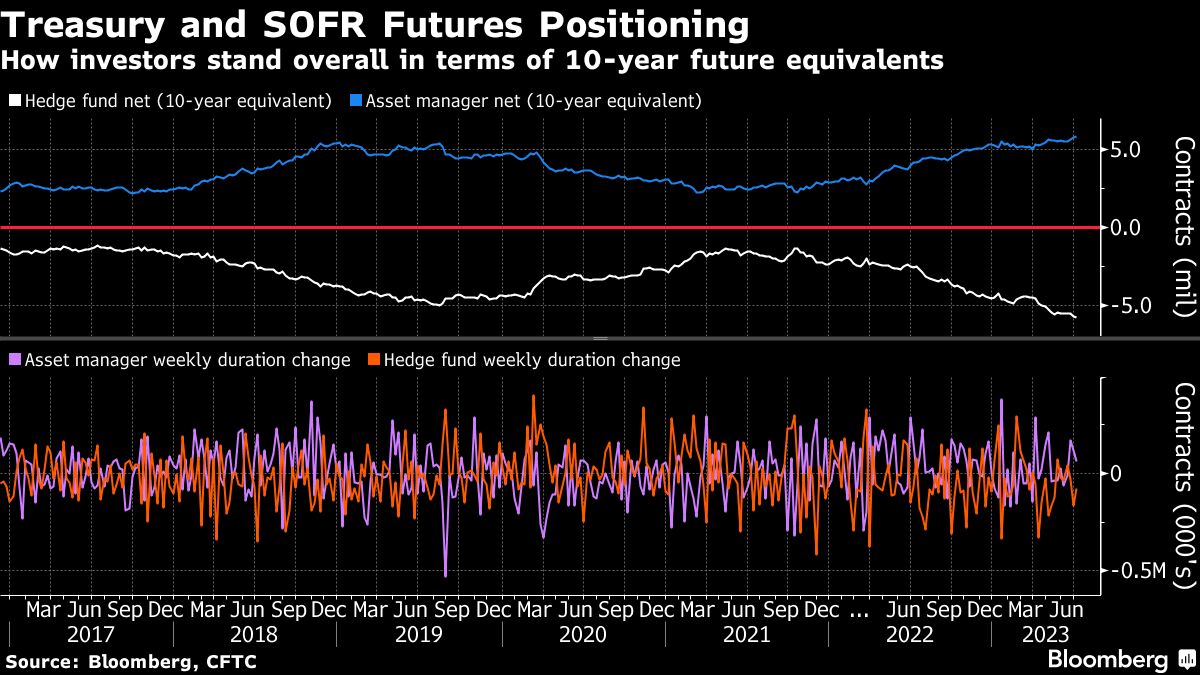
In the front-end, the latest CFTC positioning data shows asset managers are bullish futures on the Secured Overnight Financing Rate, the short-term benchmark that replaced Libor, flipping to net long for the first time since February.
Here’s a rundown of positioning in various corners of the bond market:
Block Party in Treasuries
Over 50 block trades across the futures curve have been posted since July 3.
Investors have been reevaluating their positioning and curve trades before Wednesday’s key inflation data and the Fed’s policy gathering next month — two events that could add fresh fuel to the recent steepening of the yield curve.
Aside from curve-related trades, a wave of block sales in 2-year note contracts were seen July 6.
Asset Managers Extend Futures Long
In the week to July 4, asset managers added the equivalent of 62,000 long positions in 10-year note futures to their net duration across the curve.
The largest addition was in ultra-long bonds where the net long was extended by $6.4 million per-basis-point of risk.
On the week, asset managers also flipped net long SOFR contracts, adding $3.9 million per-basis-point to net positioning.
Hedge funds added the equivalent of about 77,000 10-year contracts to their short — increasing the positioning divergence with asset managers.
Treasury Options Premium Flips to Downside
Bearish sentiment remains in Treasury options, where hedging a selloff reached the most expensive levels since March last week. (That’s shown by the so-called one-month 25-delta call-put skew which remains negative.) Last week’s flow included a downside position targeting 4.65% 10-year yields before July 14 expiry.
SOFR Options
Recent flows in SOFR options have been tilted toward hawkish hedges, including a wave of downside protection that emerged ahead of last week’s jobs report.
Meanwhile short-volatility trades via straddle and strangle selling in SOFR options remain popular, including a $18.5 million strangle option block and heavy straddle sales.
More stories like this are available on bloomberg.com
©2023 Bloomberg L. P.