
(Bloomberg) — China’s leaders are considering the option of not setting a numerical target for economic growth this year. The European Union’s executive arm warned that the bloc is facing the deepest economic downturn in its history, threatening the very future of the euro.
President Donald Trump said Americans should begin returning to their everyday lives even if it leads to more sickness and death.
Beijing fired back at U. S. Secretary of State Michael Pompeo, saying he has no evidence to back up claims that Covid-19 escaped from a lab in Wuhan.
Germany is set to hold talks to further ease restrictions even as cases rose for the first time in six days, and Spain recorded an increase in new fatalities before a vote to extend a state of emergency.
Key Developments
- Virus Tracker: cases pass 3.6 million; deaths top 256,000
- Russia adds more than 10,000 cases for fourth straight day
- Lawsuits against China escalate blame game with U.
S.
- Layoffs start turning permanent across America
- Work-from-resort: How Ken Griffin stayed on top of markets
- Covid-19 research groups are being attacked by hackers
Subscribe to a daily update on the virus from Bloomberg’s Prognosis team here. Click VRUS on the terminal for news and data on the coronavirus. See this QuickTake on unanswered questions about the virus.
U.
K. Approves 69,000 Loans (6:01 am. NY)
U. K. banks approved more than 69,000 state-backed loans on the first day of a program designed to help cash-strapped small businesses survive the lockdown. The loans are worth more than 2 billion pounds ($2.5 billion) in total, the Treasury said. More than 130,000 applications were received on Monday and lenders are attempting to process them as quickly as possible.
China May Drop Numerical Growth Target (5:53 p.m.
HK)
China’s leaders are considering the option of not setting a numerical target for economic growth this year given the uncertainty caused by the global coronavirus pandemic, according to people familiar with the matter. What may instead be unveiled at the National People’s Congress later this month is a description of the goal for gross domestic product growth, one of the people said.
Last year the target was a range of 6% to 6.5%.
A final decision hasn’t been made on how to characterize the target, the people said, who asked not to be identified discussing confidential policy deliberations. The government work report, which usually contains the GDP target, is typically revised repeatedly in the lead up to the conference.
The world’s second-largest economy is on track for its worst performance in the post-Mao era, as the impact of shutdowns to curb the disease outbreak at home is compounded by a slump in global demand as the pandemic spreads.
That has left the leadership with the choice of setting an unpalatably low growth target, an unrealistically high one, or skipping it altogether.
Iran New Cases Rise Again (5:40 p.m. HK)
Iran’s total coronavirus cases surpassed 100,000 after the country’s daily tally of infections rose for a fourth day, with 1,680 new cases overnight. The total number of fatalities reached 6,418 with 78 more deaths in the past 24 hours.
Taiwan Urges WHO to Let It Join Key Meeting (5:18 p.m.
HK)
Taiwan urged the World Health Organization to allow it to rejoin a key global health assembly later this month despite objections from China, as Taipei pushes for more inclusion in international bodies.
Taiwan needs a seat at the WHO’s annual decision-making meeting, the World Health Assembly, on May 18 to allow it access to firsthand information about the spread of the pandemic, Health Minister Chen Shih-chung said at a briefing in Taipei Wednesday.
Taiwan’s successful handling of the outbreak — and rising global concern about China’s initial response to it — has led to a groundswell of support for the island’s participation in this month’s assembly.
The U. S. has publicly backed Taiwan’s inclusion and, according to a Fox News report, is seeking support from major European nations too.
Belgium Revises Up Death Toll (5:15 p.m. HK)
Belgium reported 339 additional deaths from the pandemic, up from 97 the prior day, for a total of 8,339. The surge in fatalities is a result of revisions, as 229 hospital deaths from March 24 through May 4 were added to the tally.
None of those were cases confirmed by a diagnostic test for the virus, but 71 could be confirmed by a CT scan. The remaining fatalities are suspected cases based on medical interpretation of symptoms displayed.
Euro-Area Survival at Risk (5 p.m. HK)
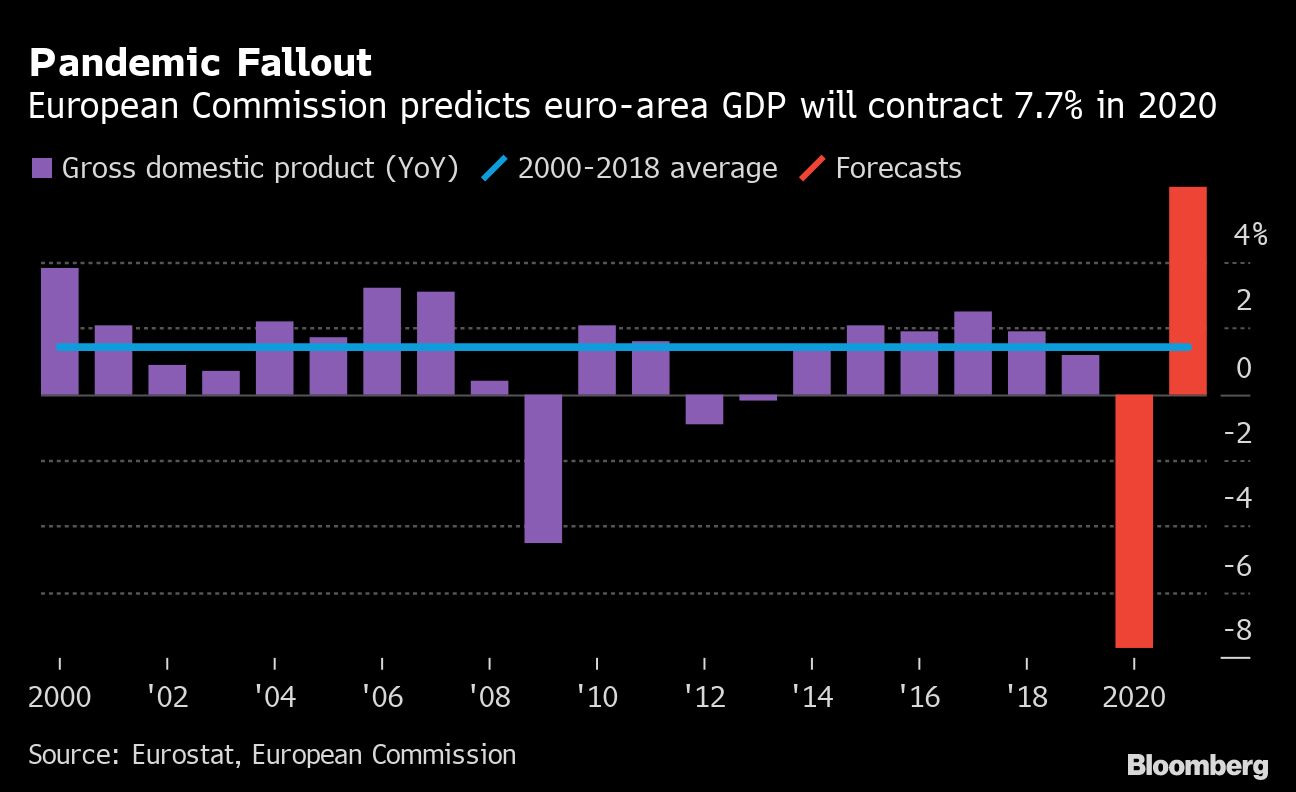
The European Union is facing the deepest economic downturn in its history, which threatens the very future of the euro currency if the crisis is badly handled, the bloc’s executive arm warned.
The euro-region economy is set to shrink 7.7% this year, sending unemployment and public debt levels surging, after governments put in place drastic measures to limit the spread of the coronavirus, the European Commission said.
Officials warned that the crisis risks widening the gulf between northern and southern euro nations and pushing the bloc to the breaking point because of differing exposures to the tourism industry and governments’ capacity to support businesses and households.
Spain Deaths Rise Before Emergency Vote (5 p.m.
HK)
The number of fatalities rose by 244 to 25,857 in the 24 hours through Wednesday, the most in four days and compared with an increase of 185 on Tuesday, according to Health Ministry data. Infections rose by 685 to 220,325 after the previous day’s gain of 867. The total number of cases was adjusted to reflect changes in data for the Madrid region.
Prime Minister Pedro Sanchez is asking parliament on Wednesday for permission to extend a state of emergency beyond May 9, even after a steady drop in the number of infections and new cases over the past month.
U.
K. Statisticians Tackle Data Gaps With Tweaks (4:40 p.m. HK)
Britain’s Office for National Statistics is battling to collect accurate inflation data during the lockdown. About one in five of the items usually used to calculate consumer-price inflation are currently unavailable, meaning the indexes that are used to set everything from mortgage and pension payments to some gilt yields will likely be more volatile, the ONS said.
It will temporarily suspend its House Price Index.
Statisticians usually rely on a network of people across the country visiting stores each month to collect about 80% of prices included, but shutdowns, social distancing and shortages have all meant that they have had to reconsider. Instead, prices will be gathered online or by phone and over a longer period.
Recession Deepens in Europe’s South (4:20 p.m.
HK)
Italy and Spain, the two European countries most severely hit by the coronavirus, are suffering even deeper slumps after record contractions in the first quarter. Lockdowns that shut hotels and restaurants meant companies experienced unprecedented declines in output and new orders in April.
In Italy, the euro area’s third-largest economy and also one of the region’s most indebted, a PMI for services dropped to 10.8 in April.
Spain saw its gauges slumping to 7.1, with hotels, restaurants and transport providers particularly badly affected. For the euro area as a whole, the reading was 13.6.
With virus infections slowing, both countries have started to ease some lockdown rules. The political wear and tear is starting to show as leaders try to maintain control amid pressure to let people get back to work and tensions within coalitions.
Italian Prime Minister Giuseppe Conte is facing speculation about how long he can survive after he was forced to apologize for delays in delivering aid. In Madrid, Pedro Sanchez faces a vote in parliament to extend his emergency powers Wednesday afternoon.
China Rejects U. S. Claims (3:54 p.m. HK)
China fired back at U. S. Secretary of State Michael Pompeo, saying he has no evidence to back up claims that Covid-19 escaped from a lab in the central city of Wuhan.
The U. S. attacks on China are part of a strategy by President Donald Trump’s Republican Party ahead of an election later this year, Chinese foreign ministry spokesperson Hua Chunying told reporters in Beijing on Wednesday. She said any discussion about the origin of the virus should be handled by scientists and not politicians.
Pompeo on Sunday claimed there is “enormous evidence” that the virus escaped from a high-security virology laboratory near the first known outbreak in Wuhan.
He has advanced the theory despite Chinese denials and a lack of consensus among U. S. intelligence agencies examining the virus’s origins.
Russian Cases Top 10,000 Again (3:50 p.m. HK)
The number of confirmed cases in Russia rose by 10,559 to total 165,929. This is the fourth straight day the country has added more than 10,000 cases, though the growth in total number of cases has slowed to 6.8%.
Total fatalities rose to 1,537 after 86 more died.
Singapore Steps Up Worker Dorm Inspections (3:45 p.m. HK)
Singapore has stepped up inspections of housing facilities for foreign migrant workers as it continues to struggle with a gulf-like divide between how coronavirus is hitting the city-state, with the vast majority of cases connected to worker dormitories. The health ministry reported 788 new cases of Covid-19 as of noon on May 6, taking the total number of cases nationwide above 20,000.
Ocado Revenue Soars; ITV Furloughs Staff (3:10 p.m.
HK)
Ocado Group Plc’s retail revenue rose more than 40% in the second quarter as the U. K. online grocer’s sales were boosted by home shopping during the Covid-19 lockdown. The company suspended financial guidance for the year, saying uncertainty around the pandemic made it impossible to predict near-term sales trends. Earlier, Novo Nordisk A/S also reported surging sales as patients snapped up medicines ahead of lockdowns.
Separately, ITV Plc said it will furlough 800 staff, representing about 15% of its workforce, mostly from production arm ITV Studios, after the lockdown blew a hole in its summer schedule and sent advertising, which normally accounts for about half of the company’s revenue, tumbling.
It has also “taken action” on board and management pay.
France to Test Antipsychotic (3:01 p.m. HK)
France’s Sainte-Anne hospital will test the antipsychotic medicine chlorpromazine as a treatment for the coronavirus after noticing that only 3% of psychiatric patients had been sickened, compared with 19% of hospital personnel who weren’t taking the drug, Le Parisien reported.
Chlorpromazine will be tested on 40 patients with severe forms of Covid-19. Results of the study will be available in a month and may lead to broader clinical tests.
German Factory Orders Slump (2:17 p.m. HK)
German factories saw demand collapse in March, when measures to contain the coronavirus brought the economy to a sudden halt. Orders fell 15.6% from the previous month, the most since data collection started in 1991 and more than economists predicted.
While all sectors were affected, investment goods plunged heavily. The Economy Ministry warned of big declines in production due to the virus.
The larger-than-consensus drop in German factory orders for March illustrates the scale of shutdowns in the euro-area’s biggest economy, writes Bloomberg Economist Jamie Rush.
German New Cases Rise Before Talks on Further Easing (1:46 p.m. HK)
The number of new coronavirus cases in Germany rose for the first time in six days before talks between Chancellor Angela Merkel and regional leaders on a further easing of restrictions on public life.
There were 855 additional infections in the 24 hours through Wednesday morning, up from 488 the previous day and taking the total to 167,007, according to data from Johns Hopkins University.
The tracking tool reported no new fatalities from Tuesday, with the death toll staying at 6,993.
UniCredit Posts $2.9 Billion Loss (1:27 p.m. HK)
UniCredit SpA reported the second loss in a row as provisions related to the coronavirus added to the pain of one off costs for job cuts and the writedown of its Turkish unit. The net loss totaled 2.71 billion euros ($2.94 billion), as loan-loss provisions climbed to 1.26 billion euros, the Milan-based bank said on Wednesday.
Credit Agricole Sees Provision Surge (1 pm HK)
Credit Agricole SA is setting aside almost three times the amount it booked a year ago to cover souring loans because of the impact of the coronavirus, the latest lender to try and estimate the damage to its balance sheet from the outbreak.
Provisions in the first three months of the year jumped to 621 million euros ($673 million) from 225 million euros a year earlier to take account of the worsening economic environment, the bank said in a statement on Wednesday.
China Urges U.
S. to End ‘Blame Game’ (12:18 p.m. HK)
China’s ambassador to Washington called for an end to the “blame game” over the coronavirus, in the country’s most high-profile response since U. S. President Donald Trump escalated his criticism of Beijing.
Ambassador Cui Tiankai said in a column published in the Washington Post that allegations blaming China for the outbreak’s spread risked “decoupling” the world’s two largest economies.
Increased suspicions also threatened to hurt U. S.-China cooperation to fight the disease and restart the global economy.
“It is time to end the blame game,” Cui said. “It is time to focus on the disease and rebuild trust between our two countries.”
For more articles like this, please visit us at bloomberg.com
©2020 Bloomberg L.
P.