
(Bloomberg) — Almost 10,000 people in the U. K. have been given an experimental Covid-19 vaccine from AstraZeneca Plc and the University of Oxford, a key step toward finding a shot that will help control the pandemic. Johnson & Johnson wants to start Phase 3 trials of its vaccine in September.
Germany reported the highest number of new coronavirus cases in about six weeks, with the rate for new infections above a key threshold for a sixth consecutive day.
Its economy shrank by 10% in the second quarter.
The number of Americans killed by the virus exceeded 150,000 on Wednesday as death tolls surged to records in some of the hardest-hit and most populous states. Mexico’s economy sank the most on record.
Key Developments:
- Global Tracker: Cases exceed 17 million; deaths pass 667,000
- Virus relief talks in Congress stalemated as time runs short
- Kitchen table beats office for 335,000 bankers working from home
- Virus upsurge threatens South Europe’s tourism revival
- As school looms, what we know about kids and Covid-19
- What you should do about work if you come down with Covid-19
Subscribe to a daily update on the virus from Bloomberg’s Prognosis team here.
Click CVID on the terminal for global data on coronavirus cases and deaths.
Poland Weighs New Measures (7:27 a.m. NY)
Poland will decide next month on new steps to tackle its widening Covid-19 epidemic after reporting the biggest one-day rise in new cases, the prime minister said.
The European Union’s biggest eastern economy registered 615 new cases, mostly in the southern regions of coal-rich Silesia and Malopolska.
The overall number of cases reached 45,031, while deaths rose by 15 to 1,709.
Redhill Biopharma Starts Trial (7:05 a.m. NY)
Redhill Biopharma initiated a global Phase 2/3 clinical study of opaganib as a treatment for patients hospitalized with severe infection. The trial will include as many as 270 patients at sites across Europe, Latin America and other regions.
Mexican Economy’s Record Plunge (7:00 a.m.
NY)
Mexico’s economy sank the most on record in the second quarter, putting the pace of the recovery in doubt and posing a dire challenge to President Andres Manuel Lopez Obrador.
Gross domestic product in the three months through June fell 17.3% compared to the previous quarter, according to preliminary data. The result, the worst in data going back to 1993, came in slightly worse than the median estimate for a 17% drop from economists surveyed by Bloomberg.
Philippines Reports Record Daily Cases (6:55 a.m.
NY)
The Philippines’ cases rose by a record on Thursday to 89,374, with recoveries also posting the highest daily increase after an overhaul in data reporting.
The Department of Health said there are 3,954 new infections, the highest single-day tally, of which 1,320 are fresh cases from the last three days. It also reported 37,166 recoveries, which more than doubled the total to 65,064 and was due to the “faster and more accurate tagging of health statuses” on the government’s online reporting platform, the department said.
Brazil Eases Entry Rules for Foreigners (6:51 a.m.
NY)
Brazil eased rules for foreigners entering the country by air, according to a decision published in the official gazette.
Visitors planning to stay for as long as 90 days must present proof of health insurance for the entire period of the trip. Entry by land or waterways remain restricted.
J&J Phase 3 Vaccine Trial (5:37 p.m. HK)
Johnson & Johnson wants to start Phase 3 Trials of its Covid-19 vaccine in September, the company said in a statement.
The drugmaker’s experimental vaccine protected a handful of primates with a single shot in an early study, prompting the company to start trials in humans this month.
A study published in Nature showed that its candidate elicits a strong immune response that protects against infection.
Astra Gives Shots to Almost 10,000 in U. K. (5:12 p.m. HK)
Almost 10,000 people in the U. K. have been given an experimental vaccine from AstraZeneca Plc and the University of Oxford, a key step toward finding a shot that will help control the pandemic.
AstraZeneca is also well on its way to administering shots to 5,000 volunteers in a late-stage trial in Brazil and may scale up the size of its studies there, Chief Executive Officer Pascal Soriot said Thursday in an interview with Bloomberg TV.
Subjects are being enrolled in South Africa, and a test in the U. S. is about to begin.
U. K. Lengthens Self-Isolation Period (5:00 p.m. HK)
The U. K. lengthened the self-isolation period for coronavirus patients to 10 days from seven as health authorities seek to prevent a renewed surge in cases of the disease.
The change in guidance was issued on Thursday by England’s Chief Medical Officer Chris Whitty and his counterparts in Scotland, Wales and Northern Ireland, and is effective immediately.
It is based on evidence that people can still be infectious 7-9 days after first showing symptoms.
Japan Sees Economy Shrinking 4.5% (4:51 p.m. HK)
Japan’s government sees its pandemic-hit economy shrinking around 4.5% this fiscal year, according to mid-year projections released Thursday by the Cabinet Office.
Gross domestic product should rebound next fiscal year, growing about 3.4% in price-adjusted terms, it said.
Inflation is forecast to remain lackluster, with the overall consumer price index dropping 0.3% in the 12 months through March, before eking out a 0.5% gain the year after.
German Economy Plunged Into Record Slump (4pm HK)
Germany’s economy plunged into a record slump in the second quarter, when virus restrictions slammed businesses and households across Europe, destroying jobs and prompting an unprecedented policy response.
Output fell 10.1%, the most since the quarterly series began in 1970, with declines in exports, consumer spending and investment.
While survey indicators signal a recent return to growth, higher unemployment remains a risk, which would threaten the recovery.
Oil Trading Bonanza Saves Shell and Total (3:04 p.m. HK)
Royal Dutch Shell Plc and Total SE were saved from what many feared would be the worst quarter ever for the energy industry, thanks to their mammoth trading operations. Investors had already been warned that the coronavirus pandemic had hammered almost all parts of the energy giants’ businesses — from forecourts, to upstream, to the long-term value of assets.
But that was offset by gains from buying and selling oil, the companies said on Thursday.
Pandemic Hits Europe’s Manufacturers (2:45 p.m. HK)
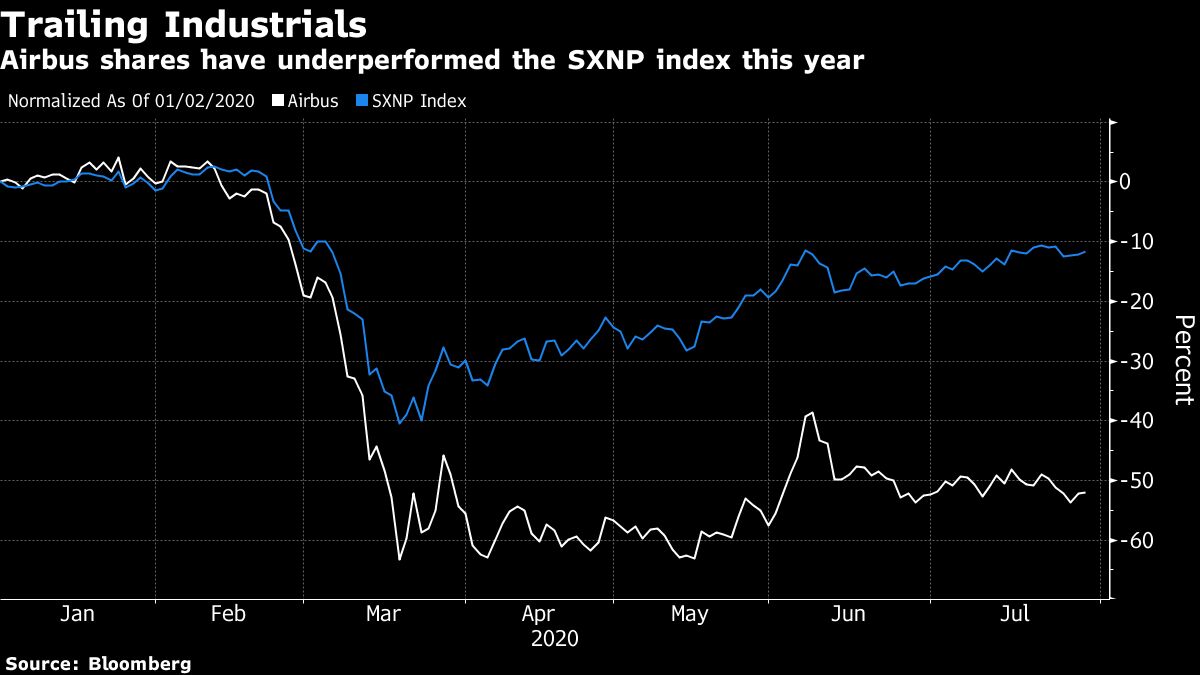
Europe’s biggest manufacturers reported plunging sales after the coronavirus pandemic shuttered factories. In one of the busiest days for corporate earnings this year, Airbus SE said it will slow production of wide-body jets after burning through an added 4.4 billion euros ($5.2 billion) in the second quarter.
Safran SA, which builds plane engines, reported a drop in revenue. With its reliance on defense, BAE Systems Plc bucked the downbeat trend in aerospace, reporting better-than-expected sales.
Tokyo Finds 367 New Cases (2:39 p.m. HK)
Thursday’s count was one infection higher than the city’s previous record. Tokyo Governor Yuriko Koike wants bars and karaoke parlors to limit their hours to 10 p.m. to help stem a recent surge.
Germany Posts Most Cases in About 6 Weeks (1:45 p.m.
HK)
Germany recorded the highest number of new coronavirus cases in about six weeks, while the country’s infection rate remained just above the key threshold of 1.0. There were 839 new cases in the 24 hours through Thursday morning, bringing the total to 208,546, according to data from Johns Hopkins University. That compares with 595 the previous day and almost 7,000 at the peak of the pandemic in late March.
There were 4 fatalities, increasing the total to 9,135.
The rise in cases this week is “very concerning,” Germany’s Robert Koch Institute said in its latest report, warning that a further worsening of the situation must be avoided.
Danish Companies Steer Clear of Aid, Report Says (1:41 p.m. HK)
Danish firms have been reluctant to tap a government aid package that provides funds to cover fixed costs for those hurt by virus-induced lockdown, the Berlingske newspaper reported.
So far they have only tapped 3.1 billion kroner ($500 million) of the 65.3 billion kroner allotted, the report said, citing government data.
Hong Kong Relaxes Dine-In Ban (1:36 p.m. HK)
Hong Kong will relax its dine-in ban and allow breakfast and lunch services at restaurants starting Friday, after scenes of senior citizens and construction workers eating meals on pavements sparked a public outcry.
Still, the financial hub reported 145 locally-transmitted cases, a daily record since the pandemic began.
Italy Extends Emergency Decree Period (1:31 p.m.
HK)
The government extended the duration of the Covid-19 emergency decree to Oct. 15 — from July 31 — according to an emailed statement.
Tokyo to Ask Restaurants to Shorten Hours (11:31 a.m. HK)
Tokyo authorities will ask restaurants and karaoke establishments to shorten their operating hours and close no later than 10 p.m. owing to a surge in virus infections, the Nikkei reported, without attribution.
The measures will be in place from Aug. 3 to Aug. 31 and the local government is considering giving a 200,000 yen subsidy to businesses that cooperate, it said.
Japan to Allow Some Foreigners’ Return (9:47 a.m. HK)
Japan’s Foreign Ministry announced the new rules under which some of its foreign residents will be allowed to return from abroad. The move follows criticism that the country’s current virus restrictions were separating families and disrupting livelihoods.
The terms stipulate that permanent residents of Japan, spouses of Japanese citizens and some others will be permitted to enter starting Aug. 5.
They must provide documentation and proof of a negative Covid-19 test conducted less than 72 hours before travel.
South Korea Has 18 New Cases (9:11 a.m.)
The country, which is battling a new Covid-19 wave after initial success in containing the virus’s spread, reported 18 new infections for a total of 14,269.
Australia Sees Worst Day of Infections (9:10 a.m. HK)
Australia announced a daily case record with its epicenter Victoria logging 723 new cases.
State premier Daniel Andrews told reporters there had been 13 more deaths from the virus, bringing Victoria’s total to 105.
Prime Minister Scott Morrison, speaking later to reporters in Canberra, called the spike “very concerning.”
The rise came despite a lockdown in Melbourne that was aimed at calming the outbreak. Worries are growing that the city’s weeks old stay-home order will need to be extended further in the southern state, taking a bigger toll on its economy.
China Has 105 New Cases, 96 From Xinjiang (8:58 a.m.
HK)
The country reported 102 local coronavirus infections for July 29, the National Health Commission said in a statement, amid its biggest spike in domestic Covid-19 cases in months. Three more cases were imported, it said.
Ninety-six of the new cases were found in Xinjiang, the far west region that has been in the spotlight as China’s treatment of its Muslim Uighur population is criticized globally.
Hanoi Halts Big Gatherings Amid Rise (8:41 a.m.
HK)
Vietnam found eight more local cases in the central city of Danang and one in Hanoi, bringing the Southeast Asian nation’s total to 459.
Hanoi halted public gatherings of more than 30 people, as officials in the capital worried that the Danang cluster would spread. Bars were ordered closed and religious and cultural gatherings — as well as other large events — suspended, Hanoi’s government said on its website.
Vietnam this weekend reported its first community cases in more than three months in Danang, after having nearly claimed victory over the coronavirus.
Mexico Reports 5,752 New Cases (8:11 a.m.
HK)
Mexico reported 5,752 more Covid-19 infections, according to Health Ministry data, as cases continue to surge in Latin America. The country’s death toll rose by 485 to 45,361 — with Mexico set to overtake the U. K. as the hot spot with the third-highest number of deaths worldwide from the virus.
For more articles like this, please visit us at bloomberg.com
©2020 Bloomberg L.
P.