
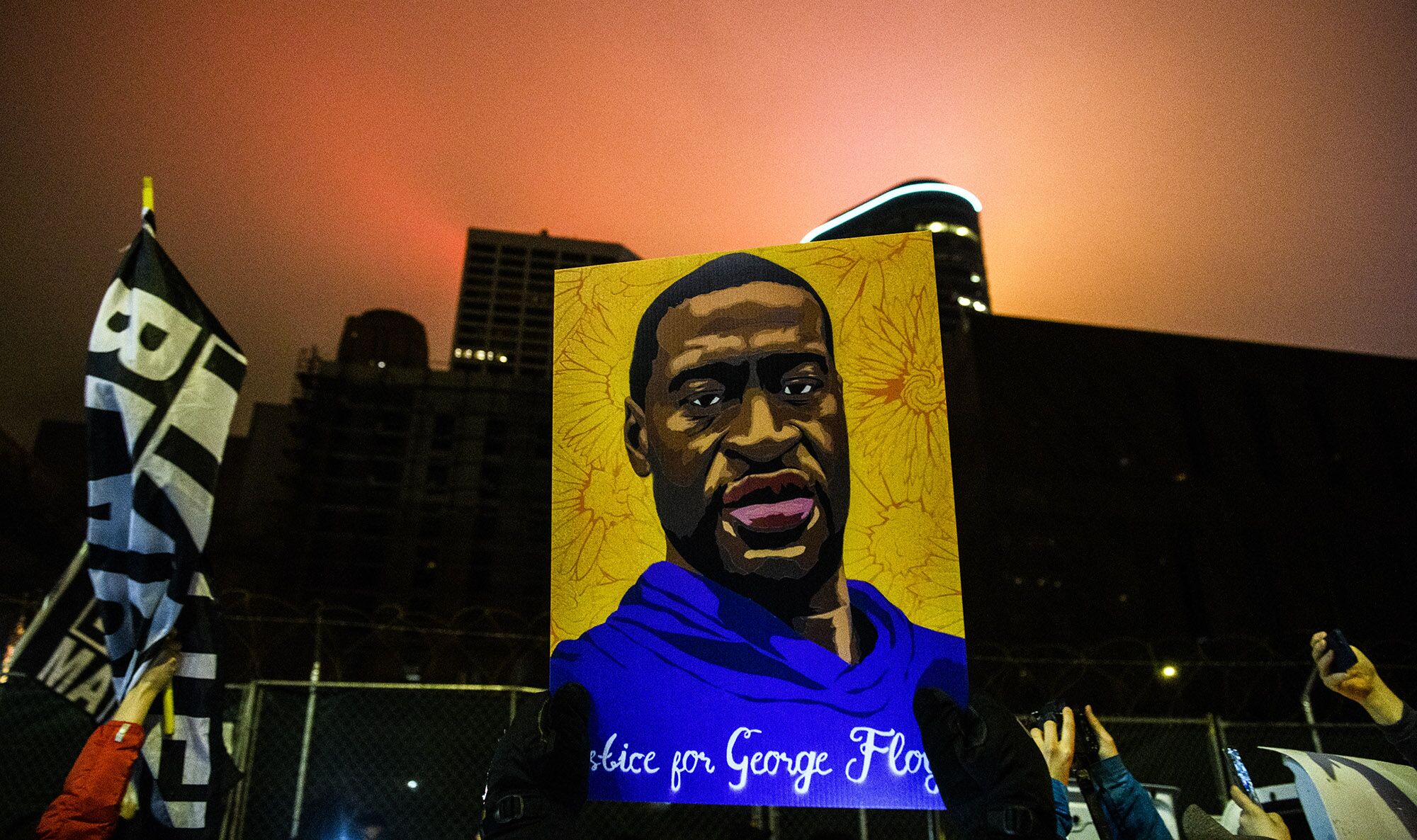
(Bloomberg) — Derek Chauvin, the former Minneapolis police officer who knelt on George Floyd’s neck for more than nine minutes last May, was convicted of second-degree murder in his politically explosive trial.
Read More: Ex-Cop Chauvin Convicted on All Counts in George Floyd’s Murder
Chauvin, 45, was charged in the death of Floyd, a 46-year-old Black man accused of passing a counterfeit bill at a convenience store.
Under Minnesota law he faces as many as four decades in prison, although he will probably get much less time under state sentencing guidelines. The jury got the case on April 19 following three weeks of emotional and sometimes graphic testimony from medical experts, family members and anguished bystanders. In rendering its verdict on Tuesday, it also convicted Chauvin of the lesser charges of third-degree murder and manslaughter.
Chauvin stood to hear the verdict read out.
After the judge ordered his bail revoked and that he be taken into custody, he placed his hands behind his back, waiting to be cuffed. He will face sentencing in eight weeks.
Chauvin, who is White, was captured in a viral video pinning Floyd chest down to the pavement, even as Floyd repeatedly cried out, “I can’t breathe.” The incident spurred millions of people across America and in other nations to take to the streets to protest police violence and racism.
The state argued that Chauvin was a bad cop who violated the department’s stated mission to serve with courage and compassion. The defense said cardiovascular problems and drug use had played a significant role in Floyd’s death and that Chauvin used reasonable force to detain an actively resisting suspect.
Verdict an ‘Inflection Point’ in Prosecution of Police (7:04 p.m. NY)
The verdict marks “an inflection point in the way that police are potentially charged and prosecuted in the United States,” said Arthur Ago, director of the Criminal Justice Project at the Lawyers’ Committee for Civil Rights Under Law. “There were a series of police officers, including the police chief, that testified against Derek Chauvin,” Ago said. “That is exceedingly unusual.”
“We will see if that type of police participation in the prosecution of other police officers continues,” he said. “Without that participation of other police officers, we’re going to slide back to where we were before this trial.”
The video of Floyd’s death was “overwhelming evidence just by itself,” said Michael Avery, past president of the National Police Accountability Project and a law professor at Suffolk University.
“Film and video of events involving police officers has made an enormous difference in the litigation of these cases, particularly on the civil side,” Avery said.
On the criminal side, Chauvin’s trial will help mold how prosecutors “duplicate this kind of result” in future cases against law enforcement, Avery said in an interview.
Legal Experts Laud Prosecutors, Crack in ‘Blue Wall’ (6:28 p.m. NY)
Legal experts lauded the state’s prosecution team and singled out the testimony of several Minneapolis Police Department officials — including Chief Medaria Arradondo, who gave remarkable testimony against Chauvin at the trial — and other use-of-force experts.
“The prosecution’s case was powerfully presented and represented a real erosion of what used to be called ‘the blue wall,’” John J.
Farmer Jr., a law professor at Rutgers University and the director of the Miller Center for Community Protection and Resilience, said in an interview. Farmer pointed to a potential “sea change” the verdict could represent.
“We have government by consent and policing by consent,” said Farmer, who was attorney general of New Jersey from 1999 to 2002. “And when it reaches the point where the public doesn’t accept the tactics used by the police, you need major reforms.”
Read More: Biden Tells Floyd Family He’s Relieved by Chauvin Conviction
Cornell law professor Valerie Hans agreed.
“The police broke a pattern,” she said. “Other police officers stepping up and describing Chauvin and the way in which he was unlawful, in their view, in his use of force.
I think that was absolutely key.”
Hans, who focuses her scholarship on the work of juries, said the verdict this jury delivered “was consistent with the evidence.” She highlighted the racial mix of the jury, which included six people of color. Diverse juries “are strong fact finders, have very robust deliberations, people test each other’s interpretations of the evidence because they come from different places in the community,” Hans said, adding that in cases involving race as a major issue, “they’re more legitimate.”
Verdict Isn’t Yet Justice But a ‘First Step,’ Minnesota AG Says (5:58 p.m.
NY)
“I would not call today’s verdict justice,” Minnesota Attorney General Keith Ellison said at a press conference. “Justice implies true restoration. But it is accountability, which is the first step toward justice.” Bystanders “stopped and raised their voices because they knew what they were seeing was wrong,” he said. After reading the names of Black people killed by police, right up through Daunte Wright and Adam Toledo, he said, “We need to use this verdict as an inflection point.
What if we prevented the problem rather than trying these cases?” He said that “the work of our generation is to put unaccountable law enforcement behind us.”
Biden Scraps Jobs-Plan Speech, Unclear If He’ll Speak on Verdict (5:33 p.m. NY)
It’s not yet clear whether President Joe Biden will speak following the verdict. Staff scrapped a planned speech on his jobs plan and declined to comment on whether he would instead respond to the trial outcome.
Earlier he’d said he was praying for “the right verdict”
Jury in Courthouse, Crowds Outside Chant for End to Hate (4:57 p.m. NY)
Crowds are building outside the courthouse where the verdict will be read. They are chanting “Stop hate now!” The jury, which has been sequestered in a hotel since Monday, is now in the building, according to Court TV.
George Floyd Chants Begin Outside the Cup Foods Store (4:49 p.m.
NY)
George Floyd chants have started outside of the Cup Foods near where he was killed. The crowd is pretty small so far.
Minnesota Governor Reportedly to Make Statement in About Two Hours (4:29 p.m. NY)
Courthouse Area Boarded Up as Minnesota Braces for Verdict (4:03 p.m. NY)
Around downtown’s Hennepin County Courthouse, where Chauvin was on trial, the government center looks like a makeshift military base.
Fencing and barriers, National Guard troops and police surround the building and large military vehicles are parked outside. Businesses are boarded up. The measures are part of the city and state’s preparations for the trial, and they were ramped up this week in the wake of the police killing of Daunte Wright in neighboring Brooklyn Center. Minnesota Governor Tim Walz has activated more than 3,000 National Guard troops, declared a state of emergency and called in law enforcement help from other states.
That militarized presence has expanded beyond the immediate area around the courthouse to the area closer to the Cup Foods store where Floyd was killed.
Minnesota AG to Hold Presser 20 Minutes After Verdict Is Read (3:49 p.m. NY)
Minnesota Attorney General Keith Ellison says he will hold a press conference 20 minutes after the reading of the verdict is done.
Biden Praying for ‘the Right Verdict’ (3:46 p.m.
NY)
President Joe Biden said he’s praying for “the right verdict” in the trial of the police officer charged with George Floyd’s murder, and that he called Floyd’s family after the jury began its deliberations.
Verdict to Be Read in Open Court (3:43 p.m. NY)
The note from the court was brief: A verdict has been reached and will be read in open court between 3:30 and 4:00 p.m.
Minnesota is on central time, so the verdict will be issued at 4:30 p.m. in New York. The total amount of time the jury spent deliberating was less than 11 hours.
For more articles like this, please visit us at bloomberg.com
©2021 Bloomberg L. P.