
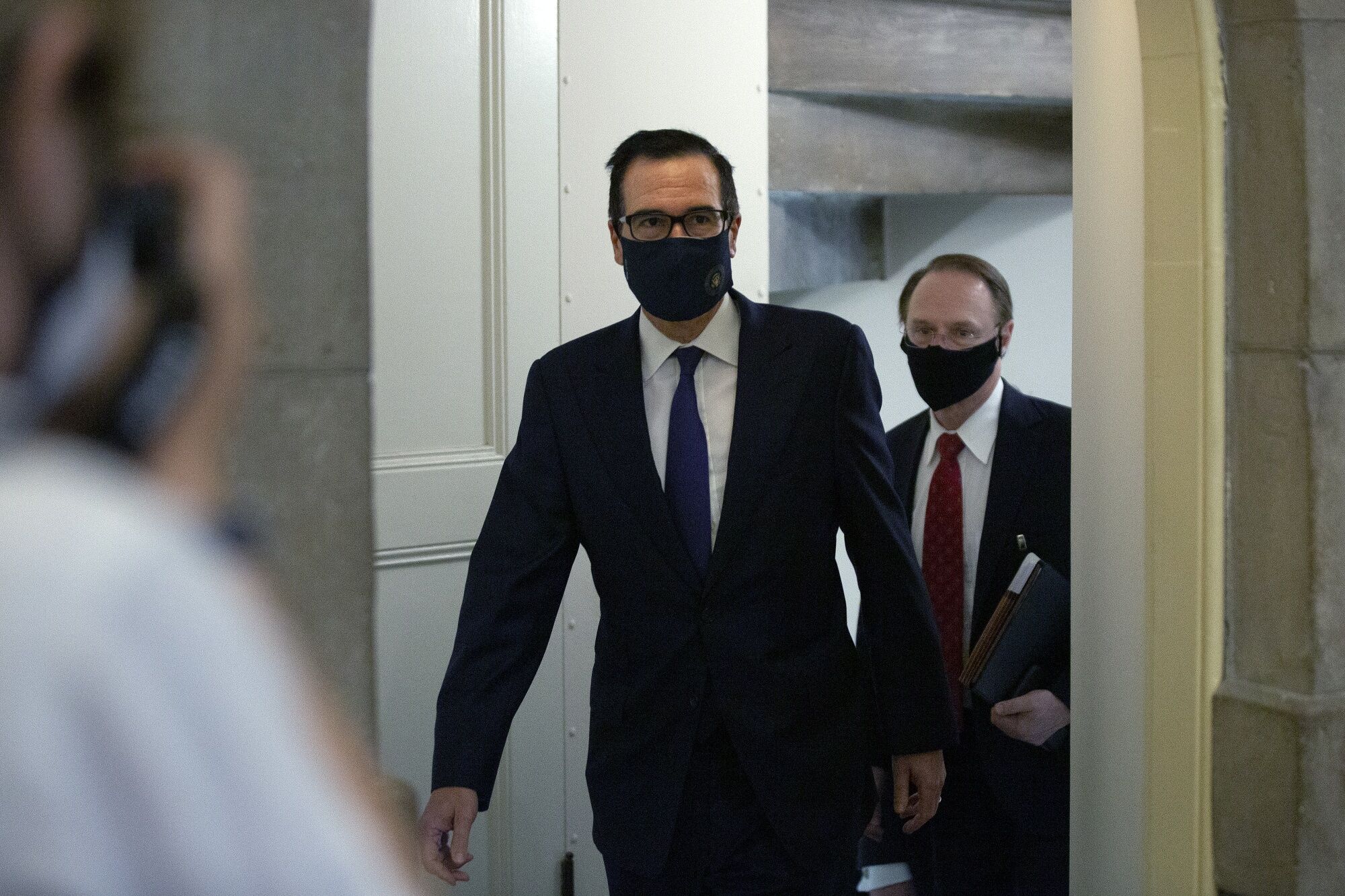
(Bloomberg) — The latest round of negotiations between White House officials and top congressional Democrats on a virus relief package produced some concession but left the two sides far apart on many issues, Senate Democratic leader Chuck Schumer said.
White House Chief of Staff Mark Meadows and Treasury Secretary Steven Mnuchin said they were bringing some fresh proposals to Tuesday’s meeting in an effort to jolt the talks, though they didn’t give details.
“They have made some concessions which we appreciated.
We made some concessions which they appreciated,” Schumer said after the meeting, adding that they “are still far away on a lot of issues.”
But in a sign of movement in the talks, Schumer said the two sides were exchanging detailed written proposals.
Heading into the meeting, Meadows and Mnuchin said President Donald Trump is weighing using executive authority for some virus aid if no deal is reached.
Trump has said he is contemplating unilateral action on evictions, unemployment and the payroll tax. Meadows said they hope to make enough progress Tuesday to make that unnecessary.
House Speaker Nancy Pelosi and Schumer said they will meet Meadows and Mnuchin on Wednesday, as well as Postmaster General Louis Dejoy on U. S. Postal Service funding needs, which Democrats want in the stimulus package.
Senate Republicans expressed frustration as big differences on major issues such as aid for the unemployed and for states still stand in the way of a comprehensive virus relief deal.
That has some Republican senators pressing for floor votes on GOP-only proposals as the prospect of getting an agreement with Democrats this week becomes less likely.
But the GOP is divided and Senator Majority Leader Mitch McConnell said any agreement would have to have support from a majority of Democrats even if some Republicans don’t like it.
“if you’re looking for a total consensus among Republicans, you’re not going to find it,” McConnell told reporters.
Whatever the White House and Democrats agree to “is something I’m prepared to support, even if I have some problems with certain parts of it,” he said.
Trump appeared to break with Republicans on aid for the unemployed.
GOP lawmakers have argued that the $600 a week supplemental unemployment insurance that was in the last stimulus and that Democrats want to continue is too much. Various Republican plans would reduce it to $200 and eventually settling at about 70% of replacement wages for most workers.
Asked in an interview with Gray TV whether people should continue to get $600 in extra unemployment aid, Trump replied, “”Yeah.
I want to get them – I want to get them a lot.”
Schumer said the differences among Republicans have made the negotiations more difficult. “They don’t yet really have a strategic plan, they have little pieces that are supported by some Republicans,” he said.
The negotiators are trying to reconcile differences between the $3.5 trillion Democratic plan passed by the House in May and the $1 trillion package that Senate Republicans introduced last week.
The major sticking points remain the amount of supplemental unemployment insurance that has expired, Democrats’ insistence on including state and local government aid and McConnell’s demand for liability protections for employers.
Many lawmakers said they expected the talks to extend into next week. The Senate is scheduled to leave for an August break on Friday and the House is already out.
But lawmakers could be brought back to vote on 24 hours notice.
In the meantime, the $2.2 trillion in stimulus passed in March is drying up and job losses may be accelerating as a surge of coronavirus cases across the country has forced some states to retreat from plans to let businesses reopen. Overall U. S. employment dropped back-to-back the last two weeks in July, particularly in areas where covid cases are surging, according to an analysis by researchers at the Federal Reserve Bank of St.
Louis using real-time data from Homebase, an employee scheduling and time tracking tool used by more than 100,000 businesses.
For more articles like this, please visit us at bloomberg.com
©2020 Bloomberg L. P.