
(Bloomberg) — Morgan Stanley is calling a bottom for emerging currencies amid their worst year since the global financial crisis.
Analysts including James Lord and Filip Denchev raised the developing-markets group to neutral from bearish last week and reiterated their view in a note sent Sunday, partly on their expectations that the Federal Reserve has caught up with inflation and will likely begin to slow the pace of rate increases.
Investors can start to “lean against” dollar strength as less aggressive monetary policy “should result in more stable markets,” they wrote in a note.
Emerging-market currencies are now “more or less in line with our current year-end forecasts” and the analysts don’t see an attractive risk/reward in cutting those projections just to maintain a bearish view.
A strengthening dollar, the yuan’s relentless slide and war in Ukraine have been a toxic mix for emerging-market currencies this year. Only four of the 23 developing-nation exchange rates monitored by Bloomberg have made any headway against the greenback in the year to date.
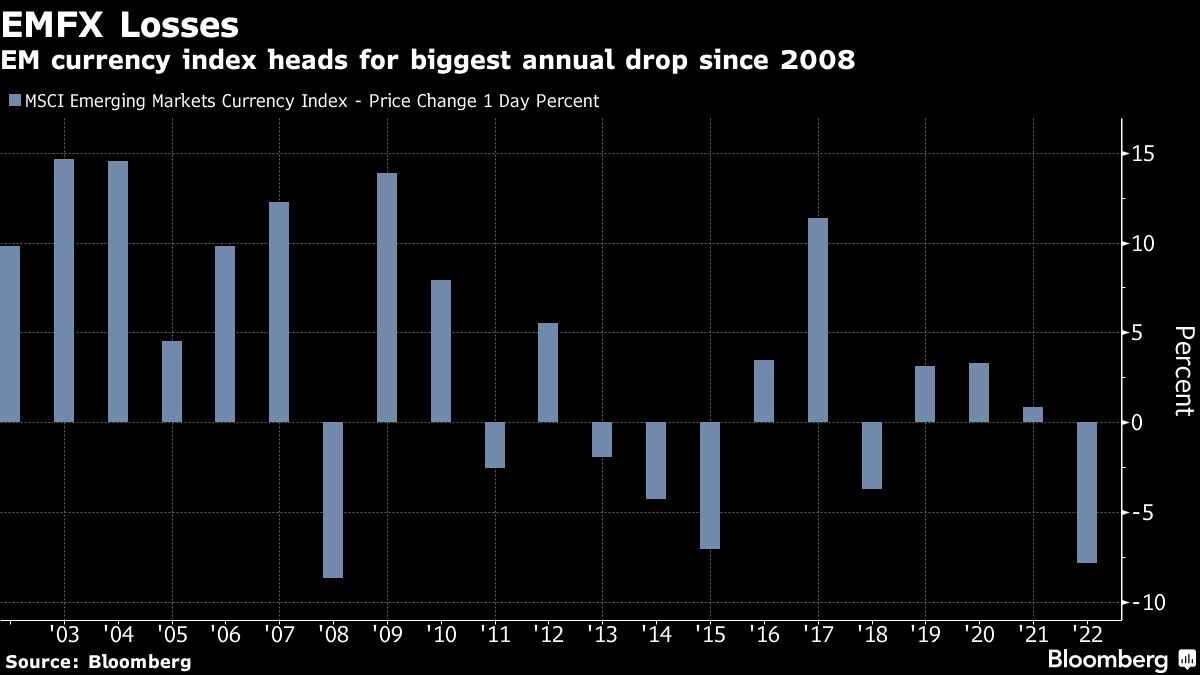
MSCI’s gauge of emerging-market currencies has weakened about 8% this year, near the record annual drop of 8.7% posted during the 2008 crisis.
Growth Model Flips to Modestly Bearish on the Dollar: JPMorgan
According to Morgan Stanley, other supporting factors include China potentially shifting away from Covid Zero, and positioning in developing markets being at very low levels after months of outflows.
Still, the analysts note that their view isn’t without risks. “Sticky inflation is a clear one,” they wrote. “We are also concerned that Europe’s embargo on Russian oil that comes into effect in December could result in a oil price surge” that causes the dollar to strengthen “significantly.”
Not all investors are as optimistic.
Jon Harrison, the managing director of EM macro strategy at TS Lombard, said there will be no respite for emerging currencies due to a weaker yuan and a stronger dollar.
“The balance of risks for the dollar remains to the upside,” Harrison wrote in a note. “There is a high bar for the Fed to slow the pace of tightening, while the immediate imperative is to raise interest rates above the level of inflation.”
–With assistance from Akshay Chinchalkar and Netty Ismail.
(Corrects second paragraph to say original call was made last week and reiterated on Sunday)
More stories like this are available on bloomberg.com
©2022 Bloomberg L.
P.