
(Bloomberg) — Yale University’s hometown of New Haven, Connecticut –- long beleaguered by budget woes with its fiscal health hinging on state support and voluntary payments from the third-richest US school — is finally seeing its financial prospects brighten.
The city on the Long Island Sound, with more than a quarter of its 135,000 residents living in poverty, won its first upgrade since at least 2002 last month from Fitch Ratings, and is coming off one of its biggest budget surpluses of the past decade.
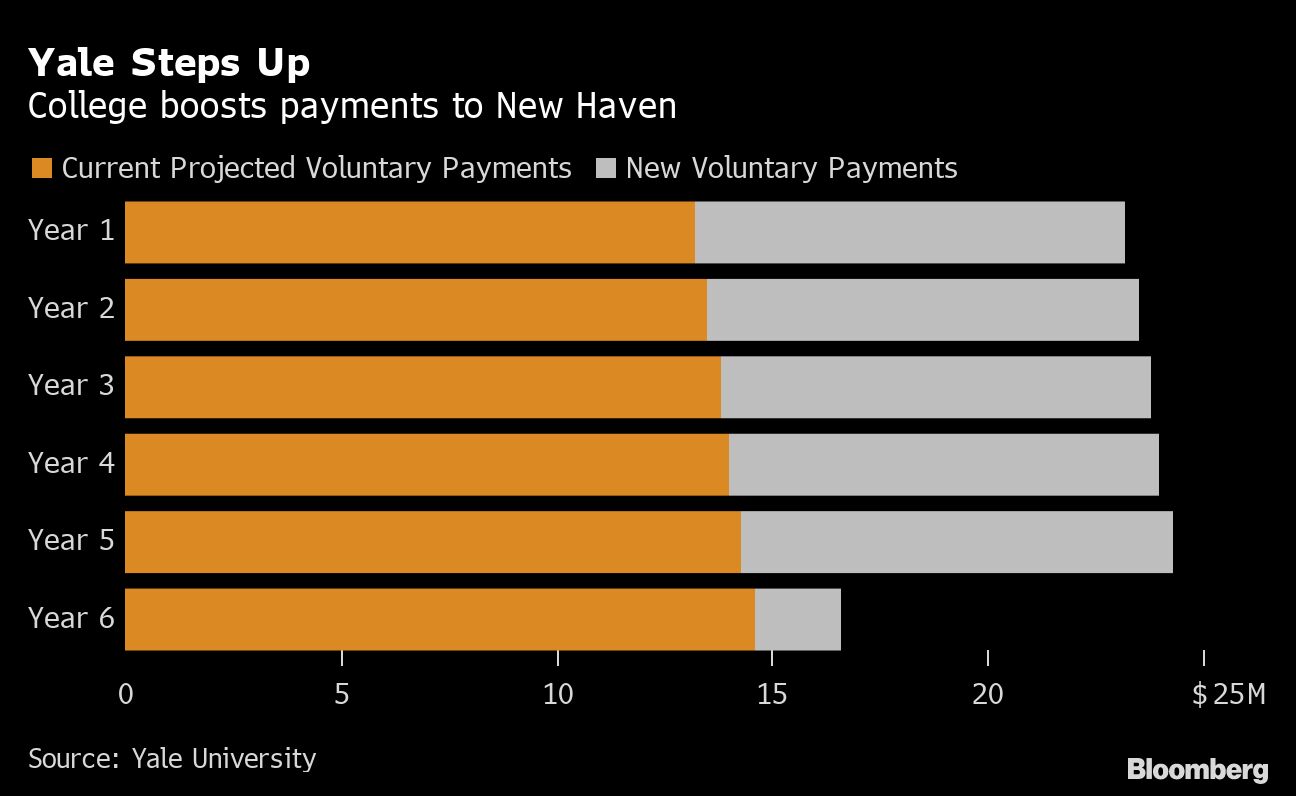
The firmer financial footing is due largely to increased state aid and an agreement by Yale — which has a $42 billion endowment and owns large swaths of tax-exempt property in New Haven — to almost double its payments.
The upshot is that the city has been able to avoid cutting services and is now in a position to chip away at liabilities such as retirement benefits that remain a drag on its fiscal health.
“Those things point us in a direction of financial stability,” New Haven Mayor Justin Elicker said in an interview. Still, the city contends with “what many large municipalities struggle with: historical underfunding of pensions, over-borrowing and the general disparity of wealth between urban centers and suburban towns in our ability to adequately collect tax revenue.”
For the last three centuries, New Haven has been inextricably linked to Yale, which doesn’t pay taxes on most of its growing share of property in the city, instead making an annual voluntary contribution.
That puts New Haven at a major disadvantage: Property taxes are the largest share of revenue for most local governments and are usually a rock-solid source of cash, which municipalities can tap to back bonds for infrastructure projects and other purposes.
A majority of New Haven’s property is exempt from taxes, half of which is owned by Yale.
The Ivy League university’s tax-exempt status has been a point of tension for decades, with residents saying the wealthy school has failed to adequately support its hometown. Yale would have owed $146 million in 2020 if it had been required to pay property taxes.
Early last year, the situation was dire.
New Haven faced a $66 million deficit, equivalent to 10% of the city’s general fund, forcing Elicker to consider two starkly different spending plans. One maintained city services but relied on increased contributions from Yale and the state; the other, labeled the Crisis Budget, included a nearly 8% tax hike, staff cuts and the shutdown of city buildings including a library and a fire station.
Read More: Yale Proves No Bulwark for Town Stung by Bond-Rating Downgrades
Both Connecticut and Yale stepped up, averting the grimmer scenario.
The state provided a $49 million payment increase to offset revenue lost to tax-exempt property — more than doubling its previous contribution — as part of a new funding formula to benefit cities grappling with that issue.
Yale also increased its financial commitment, boosting its payment and agreeing to reimburse New Haven for some revenue lost on properties it takes off the tax roll.
The decision came at a “critical inflection point,” Yale President Peter Salovey wrote in a statement.
He referenced federal stimulus, increased funding from the state, population growth and private development. “It seemed like an optimal time to strengthen our partnership.”
Challenges Ahead
Fitch said that the one-level upgrade to BBB+, three steps above junk, was due to “improvement in the city’s operating results and reserves.”
The city notched a $16.9 million surplus for the fiscal year that ended June 30, using the money to boost its rainy-day fund to about $37 million, according to a release.
That cushion will allow New Haven to tackle daunting challenges like mounting retiree benefits.
The Elm City has $1.49 billion in pension liabilities, with a funded ratio of just 42%. The city last year dropped its assumed rate of return to 7.25% from 7.75%, which Fitch called a “prudent” move. But that step also increases the contributions the city makes each year, adding to its immediate financial burden.
Another big strain comes from other post-employment benefit liabilities, an “overwhelming majority” of which are underfunded, according to Elicker. “We need to have tough conversations with our employees about how to rein in that cost.”
New Haven has capped annual borrowing at $30 million to reduce debt obligations and is negotiating with unions to trim pension costs, Elicker said, declining to provide details as conversations are ongoing.
Still, the city is seeing “remarkable growth,” the mayor said.
Building permit revenue came in $1 million higher than expected last fiscal year, a boost in and of itself and a promise of more tax revenue to come.
More stories like this are available on bloomberg.com
©2022 Bloomberg L. P.