
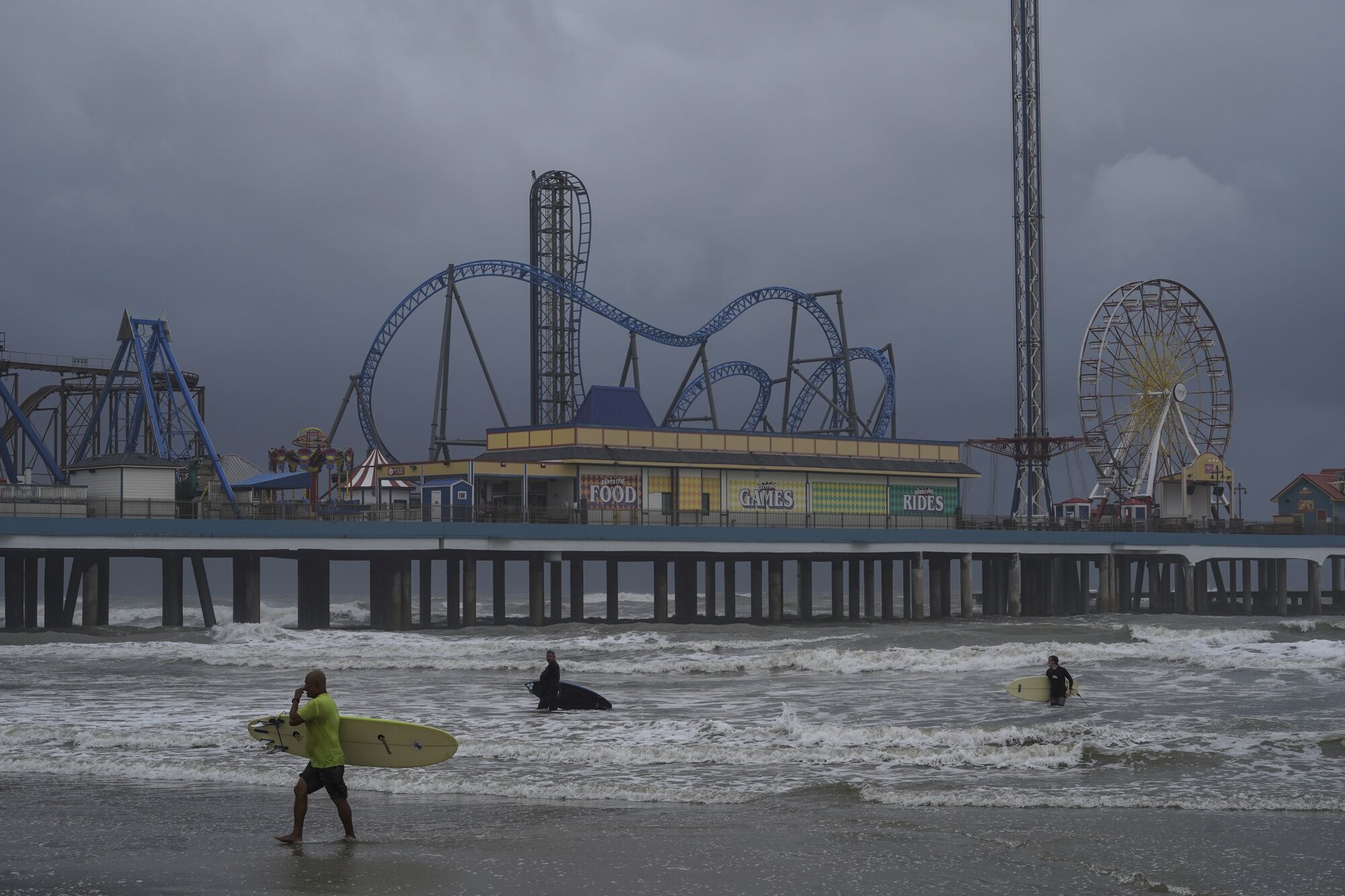
(Bloomberg) — Hurricane Laura raked Louisiana early Thursday, becoming one of the most powerful storms ever to hit the state, with a storm surge, flash floods and devastating winds that could inflict more than $15 billion in insured losses. The storm had fallen to Category 1 by 9 a.m. local time, with top winds of 85 mph.
It came ashore at 1 a.m. local time near Cameron, Louisiana, with maximum winds of 150 miles (241 kilometers) per hour, matching a record set in 1856.
Local officials said flooding was less than expected, while wind inflicted most of the damage. It killed at least one: a 14-year-old Louisiana girl who died when a tree fell on her home, according to Governor John Bel Edwards.
Laura extends an extremely active Atlantic hurricane season that still has three months to go. It will be the seventh system to hit the U. S., a record for this time of year, and the first major hurricane to hit the Gulf Coast since Michael in 2018.
The storm has prompted mandatory evacuations in coastal areas, and is targeting the heart of America’s energy industry, shutting more than 80% of Gulf oil production and a third of the region’s refining capacity.
It scored a direct hit on plants that produce chemicals and liquefied natural gas. Laura had more power than Hurricane Harvey had when it made landfall in Texas in 2017.
Key Developments:
- Laura to Join Costly List of Catastrophic Gulf Coast Hurricanes
- Oil Near Five-Month High With Hurricane Menacing U. S. Refineries
- Dozens of Oil Tankers Clustered in Western Gulf Before Laura
- U.
S. Coast Guard Closes Houston, Galveston, Freeport Ports
- Cameron LNG Pulls Last of Hurricane Crew From Threatened Plant
- U. S. East Coast Gasoline at Risk of Spike Post-Laura: GasBuddy
Lake Charles Measures Laura’s Toll (10:45 a.m. NY)
In the area near landfall in Louisiana, the extent of the devastation became clear with the dawn Thursday.
Matt Redd surveyed the damage to his Lake Charles commercial properties from his white Ford Expedition.
He stopped at the red-brick office building that he rents to a Keller Williams real-estate office, a salon and a juice bar. All three stories were drenched.
“There was water everywhere,” said Redd, a developer who has built about 80,000 square feet of office, retail and industrial space in the area. “The roof must have blown off.”
Maximum sustained winds at the Lake Charles Airport were clocked at 98 miles per hour with a gusts up to 132 miles per hour, Marc Chenard, senior branch forecaster for the U.
S. Weather Prediction Center said.
Eddie Earl Lewis Jr., a 49-year-old Lake Charles resident, said in a telephone interview that businesses and houses suffered extensive wind damage.“The major casinos down here got tore up,” said Lewis, a member of the Calcasieu Parish Police Jury, akin to a county commission. “The houses are real bad.”
In nearby Cameron Parish, home to two major liquefied natural gas terminals, port director Clair Herbert Marceaux, said roads are impassable, with downed power lines and trees and overflowing marshes.
Helicopters must wait for winds to die down before they can fly in to assess damage, she said.
Tudor Pickering Holt & Co. analyst Jordan McNiven said the early prognosis is good for the gas terminals, thanks to storm surges lower than forecast.
“It looks like we’ll make it through with limited impact,” he said. Down time could “be measured in days, not weeks.”
Texas Refinery Lets Off Pollutants (10 a.m.
NY)
In the rush to batten down ahead of Laura’s arrival, the biggest oil refinery on the continent sprang a leak and spewed unidentified hydrocarbons into the air to maintaiRe:Good morning, cyclone fansn control, according to a regulatory filing.
The facility in Port Arthur, Texas, owned by Saudi Aramco’s Motiva Enteprises, also had to deploy booms to prevent any spills from spreading into nearby waterways, the company said in a filing with the Texas Commission on Environmental Quality.
Coronavirus Keeps the Adjusters at a Distance (9:55 a.m.
NY)
Hurricane victims can usually count on one thing: a swarm of insurance adjusters. But the coronavirus pandemic is hindering their appearance.
State Farm readied hundreds of claim specialists in Dallas and Birmingham, Alabama, this week. They’re usually briefed and equipped in conference rooms, but this week, the company used drive-through tents instead.
State Farm expects to deploy video conferencing apps to handle vehicle inspections, though the company said it may also use drones.
For homeowners, it may have to do in-person inspections and workers will wear personal protective equipment and practice social distancing.
“As daylight arrives and conditions become safe for customers to look over their property for damage, we’re ready,” Chris Pilcic, a spokesman, said in an email.
Damage is Heavy in Louisiana, Governor Says (8:50 a.m. NY)
Louisiana Governor John Bel Edwards called Laura’s damage “extensive,” because the wind speed was “as promised,” even though the storm surge “appears to have been about half as what was forecasted.”
Inland areas suffered mostly structural damage from the wind, Edwards said on CNN. “It looks like we got an assist there,” Edwards said of the lower-than-predicted surge, which forecasters Wednesday had called “unsurvivable.”
Louisiana hasn’t recorded a death from the storm, Edwards said.
However, water is still coming in to Cameron and Vermillion parishes in southwest Louisiana. And assessments are just beginning, with relatively few areas surveyed. Edwards said officials haven’t been able to get a good aerial view of the damage yet but hope National Guard helicopters will be up soon.
Throughout the storm-hit region, more than 510,000 homes and businesses were without power as of 7:15 am local time, mostly in Louisiana, according to utility websites.
“Power outages are going to become more extensive,” Edwards said.
Laura’s Costs Will Fall Most Heavily on Louisiana (8:25 a.m.
NY)
Hurricane Laura is expected to cost insurance companies as much as $15 billion, with 80% of those losses coming from Louisiana and 20% from Texas, according to Wells Fargo & Co. analysts.
The losses could be a blow to reinsurers, which provide insurance for insurers, serving as backstops while earning premiums that they invest elsewhere.
“It is tough to tell how much exposure the reinsurers will have, as higher Louisiana losses will likely lead to more losses for reinsurers and a more Texas-focused event would result in more losses being retained by primary insurance companies,” analysts led by Elyse Greenspan said in the note to clients Thursday.
That’s because the insurance market in Texas is dominated by national carriers such as State Farm and Travelers, while Louisiana is served by many smaller, regional companies, the analysts said.
Hurricane Laura’s path closely resembles that of Ike in 2008, the Wells Fargo analysts said.
That storm — which also made landfall near the border between Louisiana and Texas — inflicted wind damage in the Houston area, leading to insured losses of $12.5 billion, or $15 billion in today’s dollars.
Largest Refinery Dodges a Blow (8:20 a.m. NY)
Jefferson County, Texas, which encompasses Beaumont and Port Arthur — and the country’s largest refinery — emerged from the storm battered but not ravaged by 85 mph winds.
There was no significant damage to property or industry, said spokeswoman Allison Getz.
The storm surge, which was forecast as high as 20 feet in Louisiana, was relatively gentle, she said. Though trees were down and power out, “we can handle that,” she said.
Texas Governor Greg Abbott offered an optimistic early take on CNN.
“Early reports are there were no deaths, and one reason for that is people did heed the warnings to evacuate,” he said.
Search and rescue teams “are already going throughout the entire area” looking for people who need assistance, Abbott said, adding that he was concerned about water levels and damage in Jefferson County.
The Lights Are Out on the Gulf as Laura Blows Through (7 a.m.
NY)
More than 400,000 homes and businesses in the storm’s path were without power at 6 a.m. local time, according to utility websites.
The eye of the storm, now downgraded to Category 2, has moved inland. By this weekend, a front moving across the Midwest will pick up Laura and race it east across the U. S. and out to sea, said Don Keeney, a meteorologist with commercial forecaster Maxar.
Keeney said he is concerned about flooding and crop damage across western Louisiana and parts of Arkansas, but the rains will be beneficial further east in Mississippi and Tennessee. Laura will probably be moving too fast to bring widespread flooding as it crosses the eastern U. S.
Laura could gain strength this weekend as it moves back into the Atlantic, with winds rising to 50 mph or more.
Severe Damage Reported in Lake Charles, Louisiana (5:45 a.m.
NY)
Reports of damage in Louisiana appeared on social media after Hurricane Laura battered the state with winds as strong as 150 miles per hour. Storm chaser Reed Timmer posted videos on Twitter from the city of Lake Charles, one of several accounts showing severe damage to buildings.
Hurricane conditions were spreading farther inland across the southwest of the state, the NHC said in an advisory.
Maximum winds weakened to 110 miles an hour, while the risk of a storm surge and flash flooding remained.
Laura’s Winds Slow as it Rakes Across Louisiana: NHC (5 a.m. NY)
The hurricane has been sweeping northward across the state of Louisiana for a few hours, weakening gradually as it goes, according to the NHC. Maximum sustained winds of 120 miles an hour mean it has become a Category 3 storm, not quite as ferocious as it was at landfall, but still very dangerous.
“Even though Laura’s highest winds will decrease quickly as it treks inland, significant impacts from heavy rains and strong wind gusts are likely through at least tonight across portions of Louisiana and Arkansas,” the NHC said in an advisory.
‘Catastrophic’ Storm Surge, Extreme Winds Ongoing: NHC (3 a.m.
NY)
A National Ocean Service tide station at Calcasieu Pass, Louisiana, observed water levels rise of 9.19 feet (2.8 meters) above average, the NHC said. A University of Florida observing tower near Lake Charles reported sustained winds of 86 miles per hour.
A Texas Coastal Ocean Observing Network site at Sabine Pass on the Texas-Louisiana border recently reported sustained winds of 74 miles an hours with a gust to 90 miles.
Sasol Ltd., which is building a $13 billion chemicals project in Lake Charles, will temporarily close its facilities.
‘Extremely Dangerous’ Laura Hits Louisiana: NHC (2 a.m.
NY)
Hurricane Laura brings a “catastrophic storm surge, extreme winds and flash flooding” to Louisiana, the NHC said in an advisory. On the current forecast track, it will move across the state on Thursday, weakening as it goes, and arrive in Arkansas by nightfall.
Hurricane Laura is ‘Closing In On Landfall’: NWS (1:10 a.m. NY)
Lake Charles radar is showing Hurricane Laura “closing in on landfall,” the National Weather Service in New Orleans said in a tweet at 1:10 a.m.
New York time.
A Weatherflow site in Cameron recently reported peak wind gust at 115 miles per hour.
Laura’s Eyewall Moving Onshore in Louisiana: NHC (1 a.m. NY)
The eyewall of Hurricane Laura is moving onshore over Cameron Parish in Louisiana, the National Hurricane Center said. A Weatherflow site in Cameron recently reported a gust of wind at 110 miles per hour. The storm was about 40 miles south of Lake Charles, Louisiana, with maximum sustained winds still at 150 miles per hour, the NHC said at 1 a.m.
New York time.
Hurricane Laura Not Expected to Intensify: NHC (11:24 p.m. NY)
While it remains “extremely dangerous,” Hurricane Laura is no longer expected to intensify from its current Category 4 strength because it has so little time remaining over water, the National Hurricane Center said. The storm, with maximum sustained winds now expected to stay about about 150 miles per hour, was about 75 miles south of Lake Charles, Louisiana, as of 11 p.m.
New York time.
The storm surge may now penetrate as much as 40 miles inland, and flood waters won’t recede for several days after the storm, the NHC said. Catastrophic wind damage is expected where Laura’s eyewall moves on shore.
Major Storm Evacuation Route Closed by High Winds in Louisiana (11:01 p.m. NY)
Interstate 10, a primary evacuation route for Louisiana residents fleeing Hurricane Laura, has been closed, according to the Louisiana Department of Transportation and Development.
Westbound traffic has been halted west of Atchafalaya Basin, while eastbound flows into the state have been stopped at the Texas border, it said in a tweet.
The closure will force evacuees to seek alternate routes, including highways to the north, or abandon plans to escape the storm just hours before it is expected to make landfall.
Hurricane Laura ‘As Bad As It Gets,’ Says Former FEMA Chief (10:28 p.m.
NY)
Hurricane Laura is “about as bad as it gets,” Craig Fugate, a previous administrator of the Federal Emergency Management Agency said.
Fugate, who headed the agency under President Barack Obama, said the storm surge from the hurricane would affect a very vulnerable area, with power outages and destruction from winds expected.
“We keep setting records each year with these extreme weather events,” Fugate said during an interview Wednesday evening on Bloomberg Television.
U.
S. EPA Preps for Fuel-Standard Waivers If Shortages Emerge (9:45 p.m. NY)
The U. S. Environmental Protection Agency is preparing for emergency waiver requests from fuel standards to deal with possible gasoline shortages after Hurricane Laura comes ashore.
The waivers have been used in the past to help get supplies to storm-ravaged areas and blunt shortages after pipeline failures. A team is ready to expedite requests, the EPA said.
If EPA Administrator Andrew Wheeler determines “extreme and unusual fuel supply circumstances exist in a state or region as a result of the hurricane, a temporary waiver can help ensure an adequate supply of gasoline is available in the affected area, particularly for emergency vehicles,” the agency said in news release.
EPA Expands Superfund Sites Monitored for Contamination in Texas & Louisiana (9:21 p.m.
NY)
The U. S. Environmental Protection Agency has raised the number of Superfund sites it’s assessing, increasing it to 48 in Texas and 27 in Louisiana, including former petrochemical facilities such as Brio Refining Inc. and Dixie Oil Processors Inc. in Harris County, Texas. One major concern is that violent winds and a storm surge could inundate former industrial facilities, dislodging contaminated soil and spreading toxic deposits throughout the nearby communities.
(An earlier version of this story corrected the name of Last Island Hurricane.)
For more articles like this, please visit us at bloomberg.com
©2020 Bloomberg L.
P.