
(Bloomberg) — The world’s biggest banks are heading for their worst year of credit trading in a decade as soaring interest rates and global economic uncertainty bite into their profits.
The 200 biggest investment banks are set to collectively make $8.3 billion in flow credit this financial year, a 36% yearly drop and the lowest since at least 2012, according to forecasts from Coalition Greenwich.
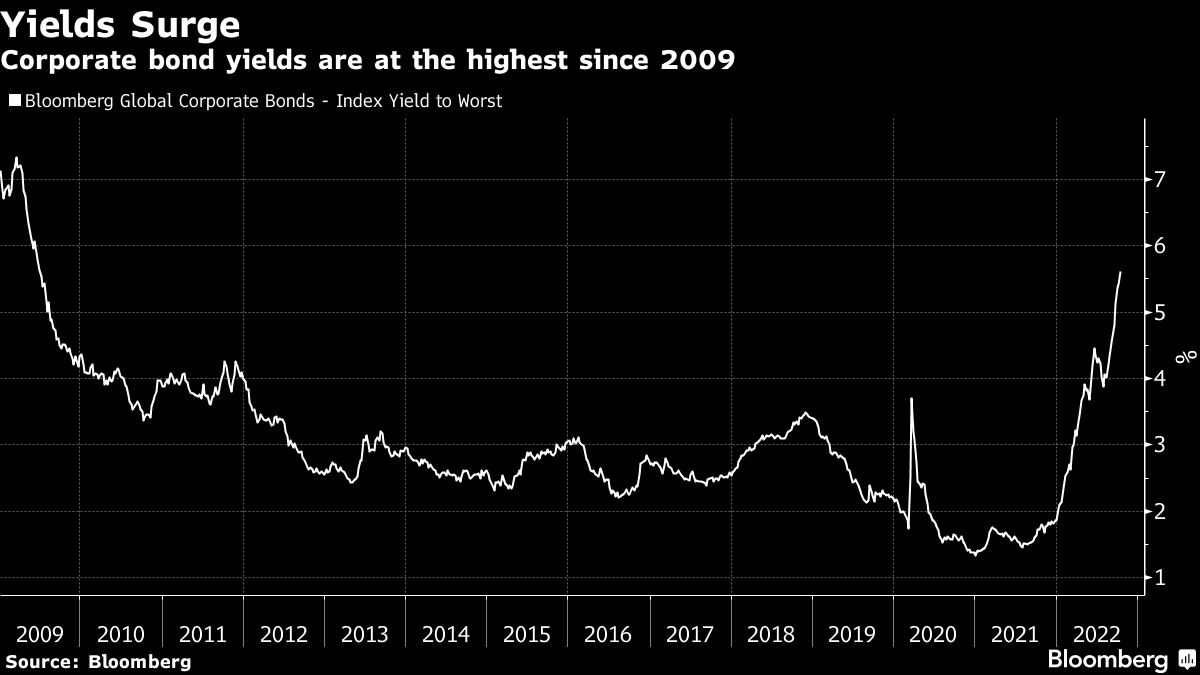
Company bond yields are at the highest levels since the financial crisis in 2009.
“This year feels especially challenging in light of the excellent revenue environment we saw in 2020 and 2021,” Mollie Devine, research director at Coalition Greenwich, said in an interview. “When revenue pools contract we tend to see banks think more critically about personnel needs. On the margins, desks start to become more cautious on new hires and to look at existing traders more carefully.”
Coalition Greenwich defines credit trading as the buying or selling in secondary markets of G10 corporate bonds and loans from G10 nations.
While several large US banks have in recent days reported strong revenue from fixed-income, currency and commodity trading, most said this wasn’t because of credit.
Goldman Sachs Group Inc. on Tuesday said rates and currencies fueled trading revenue, while Bank of America Corp. said strong trading results were driven by macro products, while also noting weaker performance for credit.
“Flows which drive revenues have been very low as the huge volatility and corresponding low liquidity in turn lowers volumes,” said Max Castle, a fixed income portfolio manager at Mediolanum. “Many investors are more likely to sit on existing cash bond positions rather than make big changes due to the liquidity challenges and instead use derivatives to alter the risk profile of portfolios.”
Volume typically increases when companies issue new debt, but global non-financial corporate bond issuance has dropped by about a third this year to about $1.6 trillion, the lowest since 2012, according to Bloomberg league table data.
JPMorgan Chase & Co. has arranged $78 billion of offerings year-to-date compared with $144 billion at the same point in 2021, while Bank of America Securities is credited with $67 billion versus $126 billion last year.
JPMorgan helped bring bond deals to market for the likes of Amazon.com Inc. and also worked on a $30 billion, 11-part transaction for AT&T Inc. and Discovery Inc. in March.
Bank of America helped arrange deals for firms including Meta Platforms Inc.
Representatives for the banks declined to comment.
Borrowers have had to contend with ever-narrower windows in which to get deals done, opting to avoid days with important data releases, central bank meetings or national holidays to maximize the available investors.
Investors are sitting on the sidelines given macro-economic uncertainty, Coalition’s Devine said.
Firms’ clients have been more reluctant to trade, with many waiting until rates have settled at a higher point.
“By the end of last year, spreads had gotten very tight, and this year there was almost nowhere to go but up,” she said.
There have been some signs of life in US primary markets this week that could help boost trading. New high-grade and junk bond sales resumed after a hiatus amid a stronger market tone.
Elsewhere in credit markets:
Americas
Three companies are tapping the US high-grade bond market on Tuesday.
- Carnival Corp. is offering a yield as high as 11.5% on a $1.25 billion junk-bond sale to refinance debt, its first offering since the company’s credit ratings were downgraded
- The pile of troubled debt outstanding expanded by about $12.1 billion last week, marking a fourth straight week of growth, according to data compiled by Bloomberg
- T-Mobile US Inc. boosted the size of its revolving credit facility to $7.5 billion and removed certain collateral pledges, as the borrower looks to take advantage of its recently achieved investment-grade rating
- For deal updates, click here for the New Issue Monitor
- For more, click here for the Credit Daybook Americas
EMEA
Morgan Stanley raised €2.75 billion ($2.7 billion) of euro debt across a two-part deal.
- Italian football club AS Roma SpA is repaying its bond investors early and in full as it seeks to lock in new debt
- German power company EnBW Energie Baden-Wuerttemberg AG is looking to sidestep the volatility of public debt markets to raise the equivalent of $1 billion privately, according to people familiar with the matter
- The screws are turning on companies that need to make refinancing decisions for more than $50 billion of junior bonds, with some taking unusual steps as the cost of issuing new debt soars
- The stress weighing on credit markets is proving a boon for Ture Invest AB, a Swedish private lender that is increasingly filling the void left by derisking banks and bond markets
Asia
Chinese junk dollar bonds dropped to a record low on Tuesday, as a property debt crisis sparked by a crackdown on excessive borrowing and a slide in home sales showed few signs of turning around.
- Dollar bonds from some Indonesian property developers are also heading for their biggest declines in roughly seven weeks as concerns about refinancing spreads across the sector
(Adds trading details from bank earnings in paragraph five.
An earlier version of this story was corrected to clarify Coalition’s definition of credit trading.)
More stories like this are available on bloomberg.com
©2022 Bloomberg L. P.