
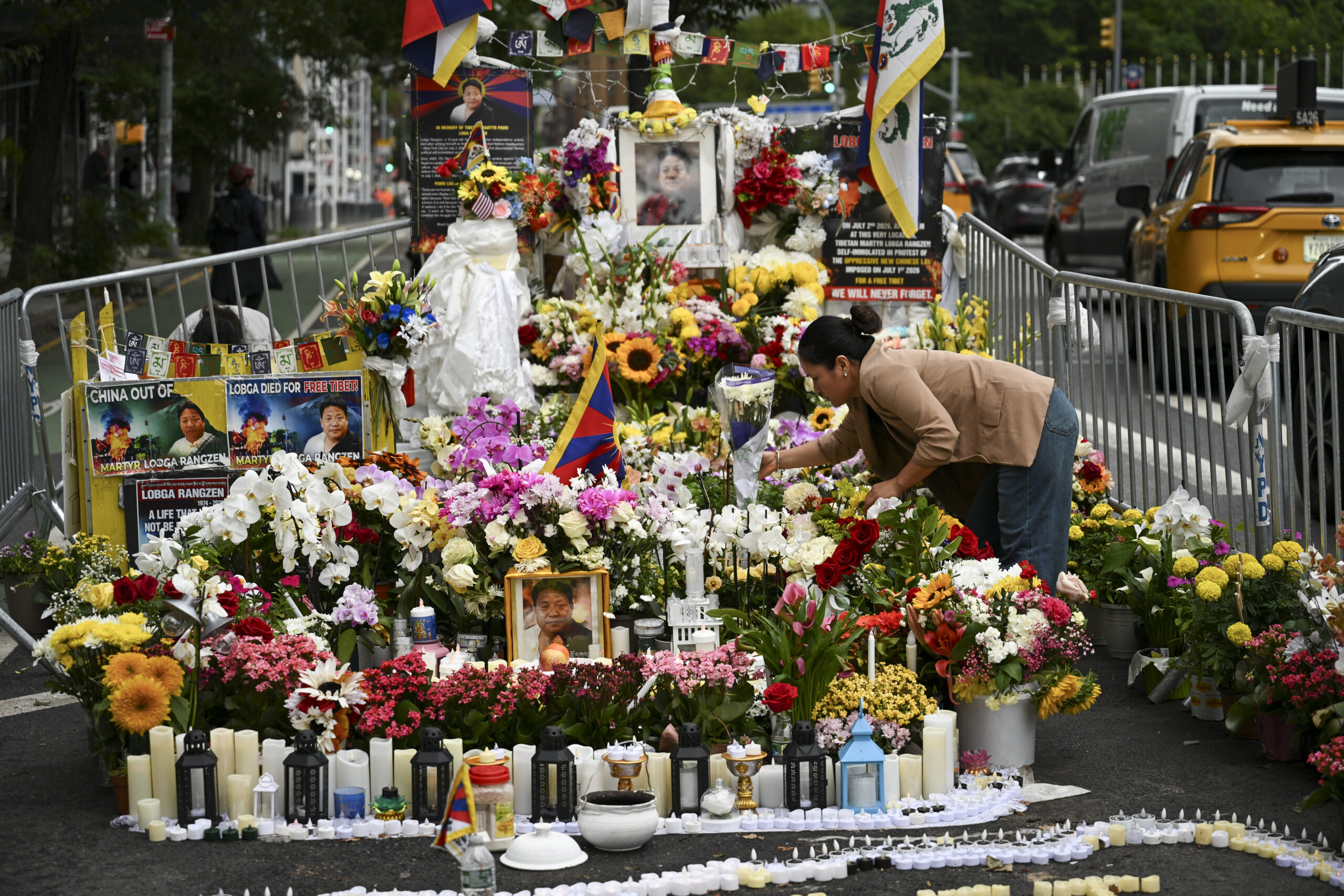
Anguish and hope: why a Tibetan set himself on fire in New York
No one knew what Lobga Rangzen was planning. Not the monk who was his friend of 30 years, not his niece in New York. The niece was watching the World Cup on TV in Queens when she heard from a friend that her uncle had “burned himself” in front of the United Nations in Manhattan. Tenzin Choekyi, 21, at first imagined a minor accident, but then came the details “and a wave of absolute terror hit me.”Rangzen, a longtime Tibetan activist aged 52, had set himself ablaze — and died.
The shocking incident barely registered in the US news, dominated that balmy July 2 night by the wedding of pop superstar Taylor Swift at Madison Square Garden on the other side of Manhattan. But Rangzen’s fellow exiled Tibetans, who have struggled to win international attention for their opposition to Chinese communist rule, greeted his passing with anguish — and respect. They swiftly erected a makeshift shrine at the scene of his “self-immolation,” heaped with flowers and ceremonial white “khata” scarves.
It has become a rallying point for Tibetan activists, below the turquoise-windowed facade of the UN.”His passing has left many of us Tibetans with the fervor to act,” said Jampa Choedup, a monk who had known Rangzen since 1997 and saw him the day before his death.- History of self-sacrifice -Rangzen was emulating the 170 monks and others who have set themselves on fire between 2009 and 2022 — mostly in China, but also in India and Nepal — in a last-resort protest after a bloody crackdown on mass demonstrations in Tibet in 2008. Beijing, which considers Tibet an inalienable part of its territory, has only tightened its control since.
On the eve of Rangzen’s death, it adopted an “ethnic unity” law that critics say will further degrade minority rights.”It wasn’t something he did abruptly,” said Jigme Ugen, president of the exiled Tibetan National Congress, where Rangzen led the New York and New Jersey chapter and was a mainstay at protests at the UN and Chinese consulate. “He clearly prepared himself.”Rangzen’s livestream of his death shows a heavy-set man striding across a street in a traditional “chuba” robe and planting a Tibetan flag outside the UN.
He then erupts in flames twice his height, dark smoke billowing. Too late, a UN security guard rushes in with a fire extinguisher. Rangzen was pronounced dead about an hour later in hospital. New York police told AFP they are still investigating the death.- ‘Joyful’ -He was the first Tibetan to self-immolate in the United States, which is home to about 25,000 Tibetans — overwhelmingly followers of Buddhist spiritual leader the Dalai Lama, who fled Tibet in 1959 and lives in India.
The niece Choekyi remembered Rangzen as a “joyful” man who loved joining weekly Tibetan “gorshey” circle dances. Choedup, the monk, said the day before Rangzen died he talked about Tibetans’ individual responsibility to seek freedom. The theme also dominated his six-minute farewell video timed to release after death.”Today, if I engage in alarming activism, it is not because I do not have food, or clothes or out of sadness.
I do it for the Tibetan nation,” he says in Tibetan, sitting cross-legged, sweat dripping from his brow.- Lifelong activism -His real name was Lobsang Palden. He fled Tibet as a young man and spent 14 years as a monk in southern India, then moved to the US in 2006, settling in Queens. He adopted the name “Rangzen” which means “independence” — echoing his desire for an independent Tibet. His English was not fluent and he drifted between jobs before becoming an Uber driver.
He told Ugen he was “married to the movement” and his forebears had fought against China. According to Ugen and Choedup, one of his uncles died in combat and another in prison after his capture while fighting for Chushi Gangdruk, an anti-China guerrilla force established with CIA support in 1958. “He grew up with these stories,” Ugen said.- ‘No need to mourn’ -As China cemented its seven-decade grip over the Tibetan plateau and abandoned negotiations on Tibet’s future with the Dalai Lama, some of his followers resorted to self-sacrifice, leaving the Nobel peace laureate in a bind about how to react.
Beijing, which contends it has improved economic and social conditions in Tibet, accused the Dalai Lama of “glorifying” self-immolations. While the Dalai Lama expressed sorrow and questioned the efficacy of such protests, some scholars criticized him for not trying to stop the practice. After Rangzen’s death, the head of the Tibetan government-in-exile, Penpa Tsering, urged all Tibetans to “cherish” their lives.”While we honor his devotion, human life is precious and must be preserved to serve the long-term struggle for Tibet,” Tsering said in a statement.
In his video, Rangzen criticized Chinese policies and urged exiled Tibetans to help build a new future. “There is no need to mourn for me,” he said.
Fri, 07 Aug 2026 04:24:33 GMT