
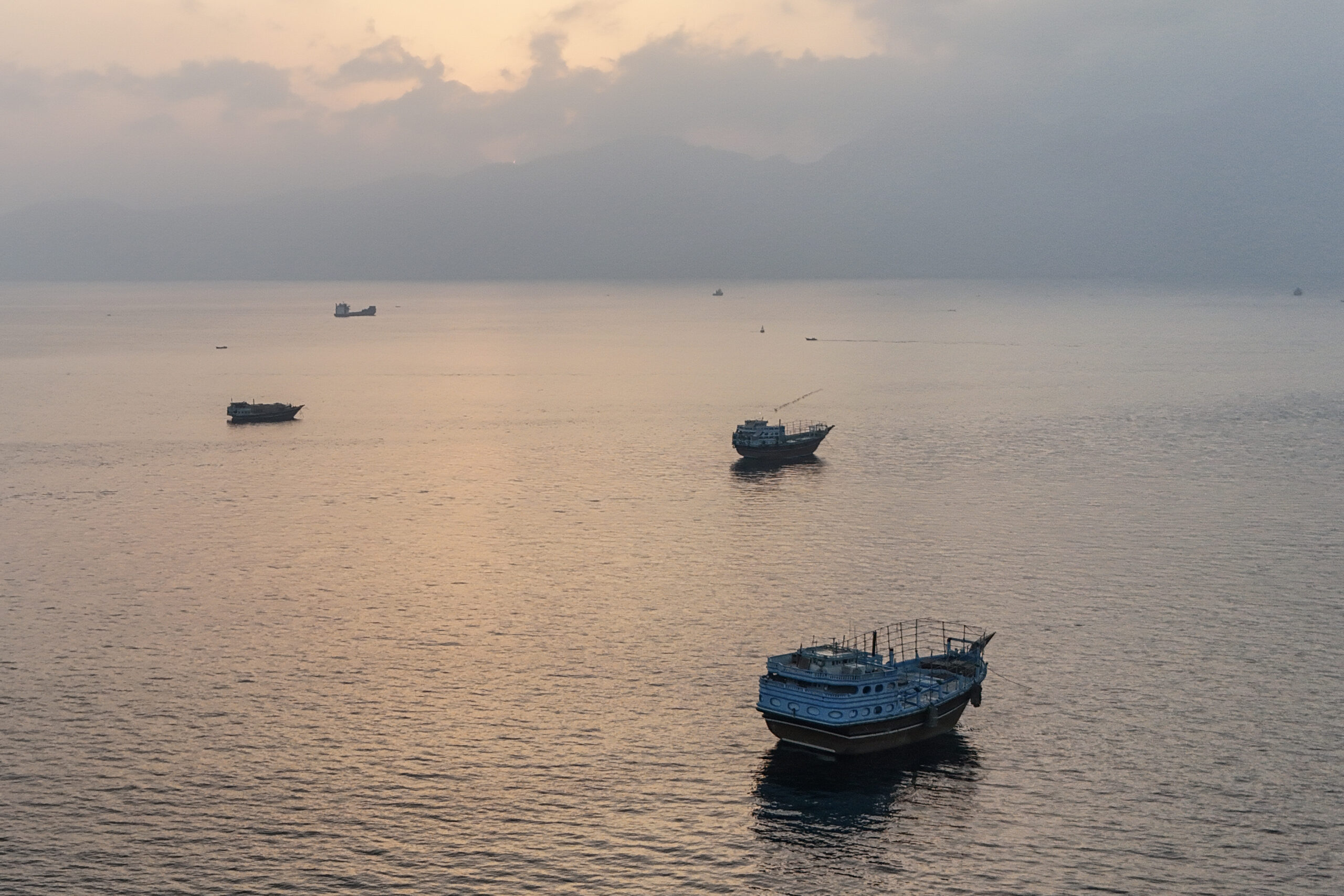
Iran warns ships not to bypass its chosen Hormuz route
Iran’s top diplomat warned Sunday that any attempt by shipping to bypass its preferred route through the Strait of Hormuz would “increase tensions” in the Middle East, as US and Iranian forces again traded attacks. The exchanges underscored the fragility of a Pakistan-brokered agreement aimed at ending the war launched by the United States and Israel in February, which disrupted shipping through the strait and rattled global energy markets.
Although a ceasefire took effect in April, sporadic violence has continued in the Gulf region, with ships passing through the Strait of Hormuz often the spark. Tehran was angered this week by Oman’s announcement, which Muscat said was in conjunction with the International Maritime Organization, of an alternative route through the strait that hugged the Omani shoreline. Tehran has continued to insist on controlling passage through the vital strait, through which a fifth of the world’s oil and liquefied natural gas travel in normal times, something it did not have before the war.
The strait comprises Omani and Iranian territorial waters, but under customary international law the two cannot generally block passage or charge tolls. Nevertheless, Iran prevented most ships from using the Strait of Hormuz during the war, granting it enormous economic leverage which it appears reluctant to give up. Tehran’s enforcement of its control has sparked repeated flare-ups with Washington, the latest of which came early on Sunday, when US Central Command (CENTCOM) said it had attacked 10 Iranian military targets over “continued Iranian aggression against commercial shipping”.
Iran said it responded to the attacks with retaliatory strikes against US bases in Kuwait and Bahrain. Both Kuwait and Bahrain denounced the Iranian attacks.- ‘Hegemonic dreams’ -At the moment, Iran insists ships transiting the strait pass through a corridor close to its own shores, though this week dozens of vessels have travelled along the opposite side of the waterway, hugging the Omani coast.”Any attempt to adopt new or separate arrangements compared to what is underway by the Islamic Republic of Iran, will only lead to more complicated situations and delays in the reopening of the Strait of Hormuz, and will increase the tensions,” Iranian Foreign Minister Abbas Araghchi said.
The published text of the memorandum says Iran will define the future administration of the strait in dialogue with Oman and the other Gulf States, but “in line” with international law. Meanwhile, Iran’s Revolutionary Guards said they were taking measures to control traffic in the strait and that vessels in violation of those measures would be dealt with more firmly than before. Mohammad Mokhber, adviser to Iran’s supreme leader, wrote on X that as long as Iran managed the strait, Washington’s “hegemonic dreams in the region will not be realised”.
Experts said there would likely be more Hormuz incidents. For Iran, “a drawn-out negotiation accompanied by controlled pressure in the strait can work to its advantage”, said HA Hellyer, of London think tank the Royal United Services Institute. While the tit-for-tat exchanges have largely been without reported casualties, the Qatari interior ministry said one of its citizens was killed on board a boat by shrapnel from “military operations in the area”, without providing further details.
The deceased was found on Sunday after his boat failed to return to port on Saturday as expected. – Israel strikes Lebanon -Israel, meanwhile, launched strikes in Lebanon as Hezbollah’s leader Naim Qassem rejected a deal to end that conflict, which has also threatened to derail the wider US-Iran peace effort. Iran called them “a blatant violation” of the truce deal. Hezbollah lawmaker Hassan Fadlallah warned on Sunday of “internal conflict” in Lebanon over the country’s agreement with Israel, signed this week, predicting the deal would not be implemented.
The agreement, which aims to pave the way to peace between the neighbours, includes plans to disarm Iran-backed militant group Hezbollah. Lebanon was drawn into the Middle East war in early March, when Hezbollah launched rockets at Israel in support of Iran, and Israel responded with heavy airstrikes and a ground invasion. Iran’s chief negotiator Mohammad Bagher Ghalibaf, meanwhile, said Iran was “seriously pursuing this issue” of ending the Israeli occupation in Lebanon in a call with Lebanese speaker of parliament Nabih Berri.
Tehran has insisted on Lebanon being part of the wider peace deal for the Middle East war. On Sunday, Lebanese state media reported a new Israeli strike on the country’s south, while the Israeli military said a soldier was killed in fighting in southern Lebanon.burs-dcp/dc
Sun, 28 Jun 2026 19:02:20 GMT